On 10 July 2026, four days before the practical end of the CNIL’s transition window, Disneyland Paris sent me a Dutch-language email explaining that it uses tracking pixels and will keep doing so unless I object. I live in the Netherlands; the controller named in the email sits in London; the rules that triggered it are French. In the same week, Carrefour, France Télévisions and Allociné sent their own versions. This page reviews the artifacts against one fixed framework, as the practice companion to the how-to on the rules themselves. It is a living review: new examples, including Italian ones as they emerge ahead of the 29 October deadline, will be added. Choosing your own route, notice, fresh opt-in, or off, is the job of the decision guide.
This is not legal advice, and nothing here declares any company compliant or non-compliant. An email shows the visible layer of an implementation, not the processing behind it. The reviews assess observable mechanics only.
What do real email tracking consent notices look like?
Real examples of email tracking consent notices now exist in the wild: Disney sent an objection-route notice that explicitly addresses historical data, Carrefour sent a branded "your choice" notification, France Télévisions sent an objection notice with a precisely explained deliverability carve-out, and Allociné put a dedicated yes/no opt-in screen in front of new tracking, with Aéroports de la Côte d'Azur adding an English-language version on the eve of the deadline, all in the days around France’s practical 14 July 2026 deadline.
Historical data explicitly addressed; one objection covers four purposes including profiling.
Strongly branded "your choice" framing, sent more than a week before the deadline.
The deliverability carve-out explained precisely, with a stated retention period.
A dedicated yes/no choice for open trackers, the type of prior-choice interface expected for new contacts.
English-language notice sent on deadline eve; one button disables three bundled purposes.
Objecting to the tracking ends the marketing emails, tying the tracking choice to the subscription.
Objecting keeps the emails, the decoupling done right; one of the few to name click tracking.
The email that arrived four days before the deadline

Disney's notice explains what a tracking pixel is, lists four purposes, names the data collected, and offers a one-click objection. Translated from the Dutch, the purposes are: managing deliverability and sending frequency; measuring and optimising campaign performance, including personalisation; building recipient profiles to target you on other websites, applications and channels; and detecting suspected fraud. The objection mechanics are the part worth studying:
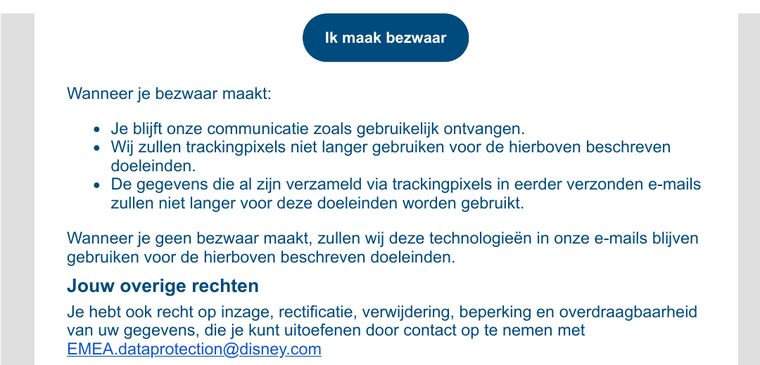
Translated: if you object, you keep receiving the emails as usual, tracking pixels are no longer used for the listed purposes, and data already collected in earlier emails is no longer used for those purposes. From the visible interface, this is strong withdrawal design: the subscription survives and historical data is explicitly addressed, two things regulators look for and many senders forget.
Strength. Recipients can refuse tracking without losing the emails, and Disney addresses previously collected data.
Question. The notice groups four materially different purposes into one objection route, including cross-channel profiling. That is simple for recipients who want all tracking stopped, but the artifact does not show whether new subscribers receive purpose-level choices for distinct uses.
Unknown. The artifact does not show Disney's new-subscriber flow or downstream enforcement.
Why does a Dutch recipient get this at all? The most plausible explanation is operational. A single European rollout is cheaper and less error-prone than trying to infer legal scope from language, profile country or other imperfect location data. One email cannot establish Disney’s complete rollout strategy, but it does show that its French transition response extended beyond a narrowly French recipient segment.
Which consent models are companies using?
The responses sort into two modes, and the distinction matters, because reading these emails casually could leave you thinking all pixel tracking has quietly become opt-out. For existing recipients, senders inform the database and offer an easy objection, using the CNIL's transition arrangement for addresses collected before the recommendation. Existing means collected before publication on 14 April 2026; later signups fall under the new-contact rules even if the form never said so. For new recipients, the expected pattern is a prior choice before non-exempt tracking begins, and Allociné's screen below is what that looks like.
Each case is reviewed on the same seven dimensions, together the Value Gravity™ implementation review: moment of choice, purpose separation, email continuity, default and interface, historical data, operational clarity, and unknowns, what the artifact alone cannot show.
France Télévisions: the precision benchmark
France Télévisions names the CNIL recommendation explicitly and lists four purposes: adapting sending frequency, measuring performance, automatic unsubscription after prolonged inactivity, and personalisation profiles. Then it does something no other artifact in the set does: it separates the exemption from the choice.
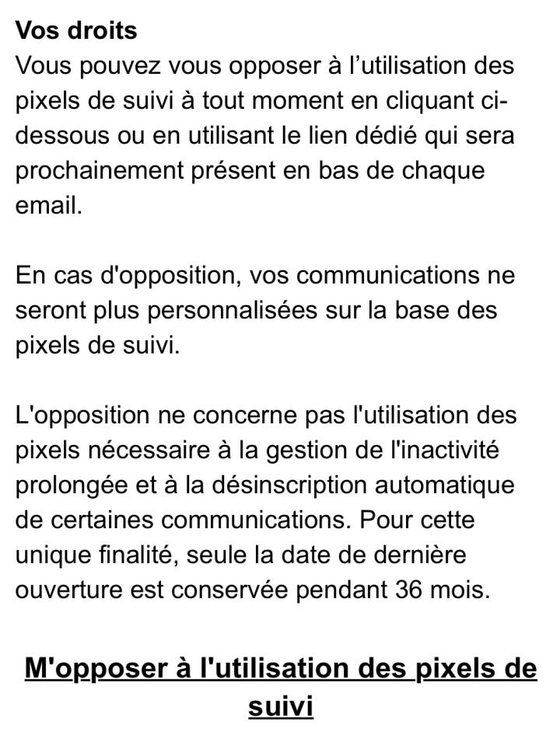
Translated: you can object at any time, and a dedicated link will soon appear at the bottom of every email. If you object, communications are no longer personalised based on pixels. But the objection does not cover pixel use needed for managing prolonged inactivity; for that sole purpose, only the last-open date is kept, for 36 months. Whoever drafted this read the recommendation, not a summary of it.
Strength. The most precise artifact in the set: it says what the objection covers, what continues under the exemption, which data point is kept and for how long.
Question. Automatic unsubscription driven by non-opens is operationally bold: open data is noisy in both directions, since Apple Mail Privacy Protection can inflate apparent activity while image blocking can make engaged recipients look inactive.
Unknown. Whether the carve-out data is genuinely isolated from other processing.
Aéroports de la Côte d'Azur: the deadline-eve notice, in English
Aéroports de la Côte d'Azur, which runs the Nice and Cannes airports, sent me this on 13 July, the day before France's practical deadline, and in English rather than French. Like Disney's Dutch notice, it is a cross-language rollout: a French sender, a French rule, a recipient addressed in English. It names the CNIL, states plainly that it collects email opens and link clicks, and lists three purposes: more relevant communications, contacting you at the best time, and successful delivery. The model is legacy objection, turned on and off by a single button.
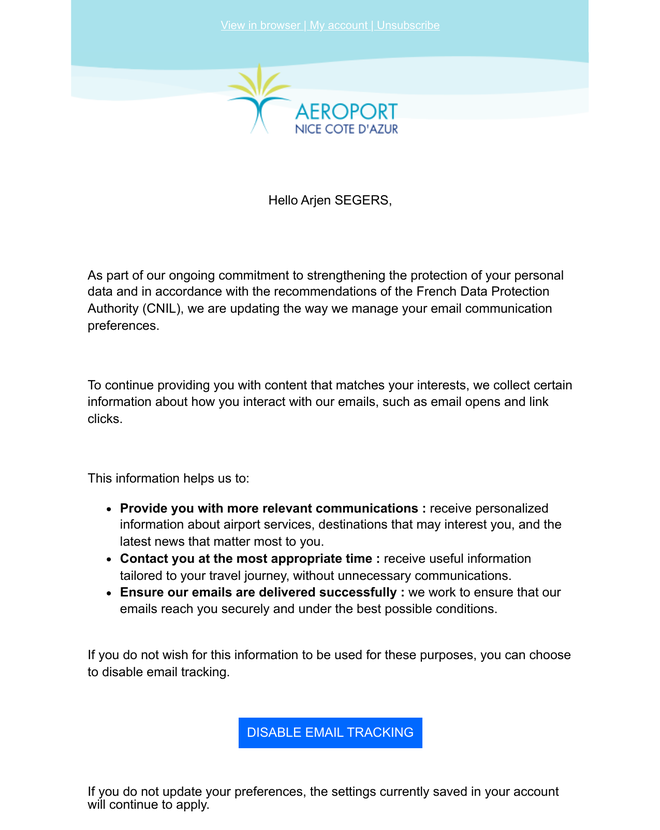
The framing is marketing-led and benefit-first: relevant content, the right timing, reliable delivery, with the compliance obligation presented as a service to the recipient. One button, "Disable email tracking", turns everything off, and the closing line makes the default explicit: if you do nothing, the settings currently saved continue to apply. That is the transition arrangement working as intended for existing contacts.
Strength. Plain, benefit-framed English, a single clear action, and a named data protection officer with the CNIL complaint route in the footer. The English rendering, like Disney's Dutch one, points to a single European rollout localised by the recipient's language rather than by legal geography.
Question. The three purposes share one on-off switch, so personalisation, which needs consent, rides in with the narrow deliverability use, which does not. There is no purpose-level choice, and the notice is silent on data already collected, the gap only Disney and France Télévisions close.
Unknown. Whether disabling stops the exempt deliverability use as well as the rest, plus the new-subscriber flow and downstream enforcement, none of which a single email can reveal.
The timing is a small finding in itself. Carrefour sent a week early, France Télévisions with room to spare, Aéroports de la Côte d'Azur the day before the deadline. Even inside one country and one rule, readiness is spread right across the calendar.
Generali: object to the tracking, lose the emails
Generali, the insurer, sent me this on 13 July under a soft subject line, "Nos communications évoluent pour mieux vous accompagner", our communications are evolving to serve you better, with no hint of tracking or consent until you open it. Inside it is warm and clear: it explains that it embeds a measurement device to see whether an email is opened, and lists three purposes, more relevant offers, better message quality, and fewer messages once emails stop being read. Then it does the thing the rest of the set is careful to avoid.

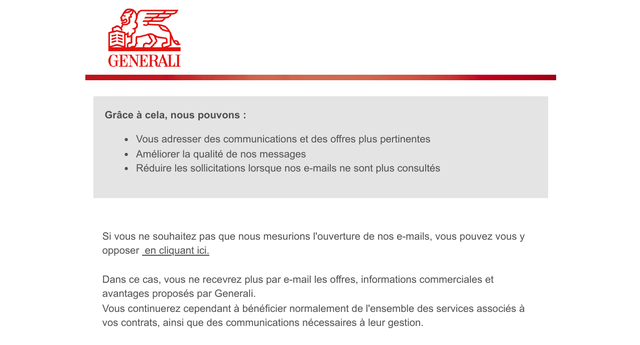
Translated: if you do not want your opens measured, you can object, but in that case you will no longer receive Generali's offers, commercial information and benefits by email. You keep the service messages attached to your contracts, the ones Generali has to send anyway. So the choice is not "keep the newsletter without the pixel", it is "accept the pixel or lose the marketing emails". That ties consent to be tracked to the subscription itself, and a consent you cannot decline without losing the emails is the weakest kind.
Strength. A warm, plain-French explanation, an honest statement of what is measured, and a clean line between marketing email and the contractual messages that continue regardless.
Weakness. The objection is coupled to the subscription: refuse the tracking and the marketing emails stop. Where Disney and Aéroports let the emails continue without the pixel, Generali makes tracking the price of staying subscribed, the coupling both regulators single out. The soft subject line, silent on the tracking change, does not help.
Unknown. Whether new subscribers get a genuine prior choice, and whether the "necessary service" carve-out is truly separated from marketing measurement.
McDonald's: the objection done right
McDonald's France sent me this on 28 July, two weeks after the French deadline, under a soft subject line, "Information relative à nos emails", though the email itself is headed "Vos emails, vos préférences". It is warm and plain: it explains what a tracking pixel is, lists three modest purposes (relevant content, fewer needless sends, better quality), and then reaches the line the whole set is really about.
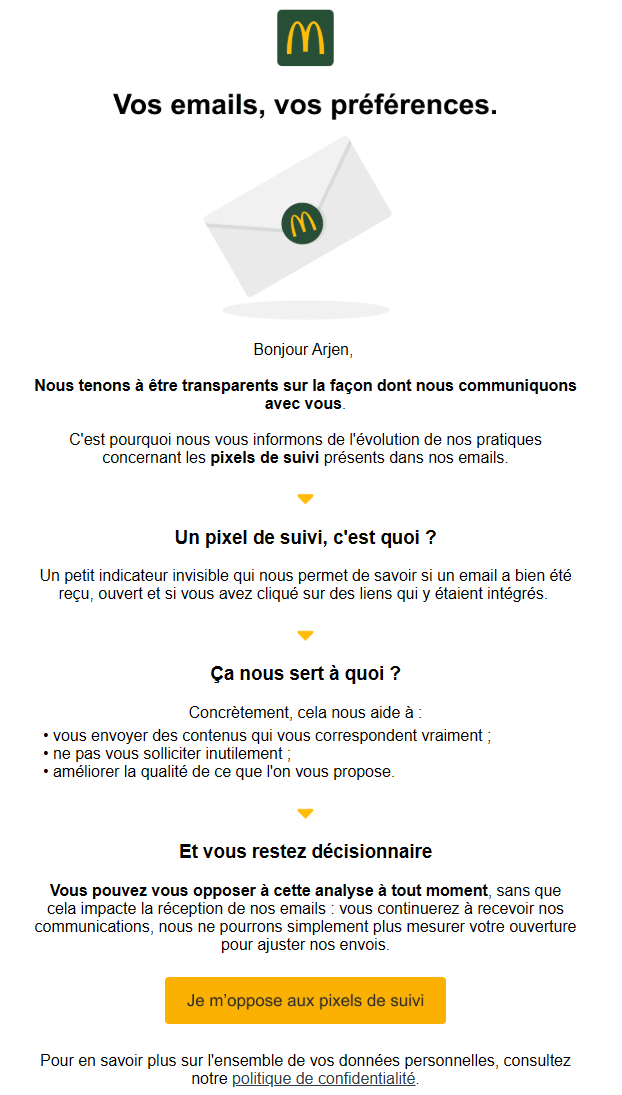
Under "Et vous restez décisionnaire", you can object to the analysis at any time, "sans que cela impacte la réception de nos emails". You keep the communications, McDonald's simply stops measuring your opens, and the single button says exactly that: "Je m'oppose aux pixels de suivi". This is the decoupling Generali got wrong, done right: objecting to the tracking does not cost you the emails.
Strength. The clearest positive example in the set that unsubscribe and untrack are different acts: object to the pixel and the emails continue, said plainly. The purposes stay modest, relevance, frequency and quality, with no cross-channel ad profiling, and it is one of the few notices to name click tracking explicitly, "si vous avez cliqué sur des liens", alongside opens.
Question. The subject line, "Information relative à nos emails", hides that this is about tracking. It is an opt-out, so tracking continues for anyone who does nothing, defensible only under the transition arrangement for contacts collected before 14 April. And a small mismatch: the pixel is described as covering opens and clicks, but the objection promises only to stop measuring your opens, leaving link tracking unaddressed.
Unknown. The new-subscriber flow, whether the objection also stops click tracking, and downstream enforcement.
What the set shows so far
Seven artifacts is a small sample, but four findings already stand out. In the clearest examples, the email subscription survives a tracking objection, these senders appear to have internalised that unsubscribe and untrack are different acts. Generali is the outlier: objecting to its tracking ends the marketing emails altogether, exactly the coupling the regulators warn against. Notices to existing databases uniformly rely on the transition arrangement, with tracking continuing unless the recipient acts. Several notices group broad purposes, profiling included, into one choice, although the available artifacts do not always reveal the complete mechanics. And historical data is addressed explicitly only by Disney and, partially, France Télévisions; everywhere else the question of already-collected opens simply does not appear. The two snapshots below add supporting evidence on both counts.
Carrefour: the branded choice

Carrefour sent its notice on 6 July, more than a week before the practical deadline, and treated it as a branded moment: "Votre choix pour les pixels e-mail", your choice about email pixels, in campaign styling. The purposes are disclosed in a detailed list, including profiling for other contexts, and appear to share one choice. The framing is the finding: a compliance obligation presented as respect for the recipient, which is exactly the reframe this regulation invites. Objection mechanics, historical-data treatment and the new-subscriber flow are not visible in the published excerpt.
Allociné: the opt-in screen

Allociné shows the second mode: a dedicated screen asking the question directly, yes or no, with a link to the tracker policy and no bundling with the subscription itself. One observation the artifact forces: in the screenshot, "Oui" is selected. Whether that is a pre-selected default, which would undermine the consent it collects, or simply the state after the sharer made their choice, cannot be determined from a static image. It is exactly the kind of detail to verify in the live flow rather than conclude from a screenshot, in either direction.
What a strong implementation needs behind the email
Every artifact above is an interface. The obligations live in the stack behind it. The interface is the visible part; consent history, pixel suppression, scoring, audiences and cross-platform synchronisation are the implementation. In marketing operations terms, a notice like these implies a persistent tracking-consent field synced to CRM, a genuine no-pixel send route for recipients who object, preference synchronisation across every sending system including the sales side, suppression of historical engagement data from scoring and audiences rather than only from reports, and evidence that all of it actually fires. "The email said so" is not a control.
That gap between the visible email and the invisible plumbing is what the free pre-check maps for your own setup: seven gates, three minutes, no email address needed. Choosing between notice, fresh opt-in and off is the decision guide. When the answer needs verifying against a real instance, the Consent & Tracking Readiness Pulse is the fixed-scope audit version: readiness report, action brief and DPO-ready pack in three working days.
Frequently asked questions
Why did Disney email me about tracking pixels?
Disneyland Paris notified subscribers, including outside France, that it uses tracking pixels in its emails and offered an objection route. The trigger is the French CNIL recommendation that treats email tracking pixels as consent-based technology, with a practical 14 July 2026 deadline, the end of the CNIL’s three-month transition window, to inform existing recipients. If you received one, you can object and keep receiving the emails without being tracked.
Do companies need consent for email tracking pixels?
In France and Italy, generally yes: both regulators treat the pixel as terminal access under the ePrivacy rules, with narrow exemptions for deliverability-only use. For databases built before the rules, France allows a transition route: inform recipients and give them a real chance to object. The details are covered in the full how-to.
What is the difference between the objection route and an opt-in screen?
The objection route applies to existing recipients: tracking continues unless the recipient acts, as in the Disney, Carrefour and France Télévisions notices. An opt-in screen, like Allociné’s, asks before non-exempt tracking begins, which is the expected pattern for new contacts going forward.
Is objecting to email tracking the same as unsubscribing?
Not always. In the clearest notices, Disney and Aéroports de la Côte d'Azur, you can object to the tracking pixel and keep receiving the emails without it. Generali couples the two: object to its tracking and the marketing emails stop, which is the coupling both regulators warn against. Unsubscribing and untracking are meant to be separate acts.
Does the email tracking pixel rule apply outside France and Italy?
The rules that triggered these notices are French (the CNIL recommendation) and Italian (the Garante provision), but the emails already reach recipients elsewhere: Disney sent its notice in Dutch to subscribers in the Netherlands. The underlying ePrivacy principle applies across the EU, and Germany's regulators have signalled their own guidance, so more markets are expected to follow.
Which companies have sent email tracking pixel notices?
Documented examples so far include Disney (Disneyland Paris), Generali, Carrefour, Aéroports de la Côte d'Azur, France Télévisions, Allociné and L'Équipe, mostly in France in the days around the 14 July 2026 deadline, with Disney's notice reaching the Netherlands. Italian examples are expected before the 29 October 2026 deadline.
Methodology and submissions
Evidence quality is labelled per case: original email received directly, official company publication, third-party publication, or recipient-posted artifact. Entries based on second-hand artifacts are reviewed more cautiously and updated when better evidence appears. Nothing here assesses lawfulness; the reviews describe observable mechanics against a fixed framework, and each case states what the artifact cannot show.
Received one of these notices yourself, in any EU market? Forward it to hello@idaday.nl or send it via LinkedIn, with the date and the country you received it in. Italian examples will be added as they emerge ahead of the 29 October deadline.