The State of Martech 2026 is out. 125 pages from Scott Brinker and Frans Riemersma, free and ungated. The chrysalis metaphor, the seventy AI use cases, the AEO chapter, the seven sponsor interviews. Worth your time. The MartechMap is now filterable by region, revenue band, and headcount, which on its own is a reason to spend an hour browsing.
But one moment in the report matters more than the rest, and most early commentary has not picked it up. Brinker and Riemersma named the role.
What does it mean that they named the role?
In the introduction, in a five-by-three table mapping where marketing was, is, and is going, the destination role for marketers is value engineer. The destination role for marketing operations is context engineer.
You may read past this and think: nice metaphor. That would be a mistake.
Disciplines without names get rounded down to common sense. With a name, three things happen. Buyers can ask for it. Talent can train for it. Leaders can hire for it. The category exists, in a way it did not exist last week.
Both have been practised quietly for years. As of this week, they have a label signed by the two most cited authorities in the space.
Why will context engineering get all the budget?
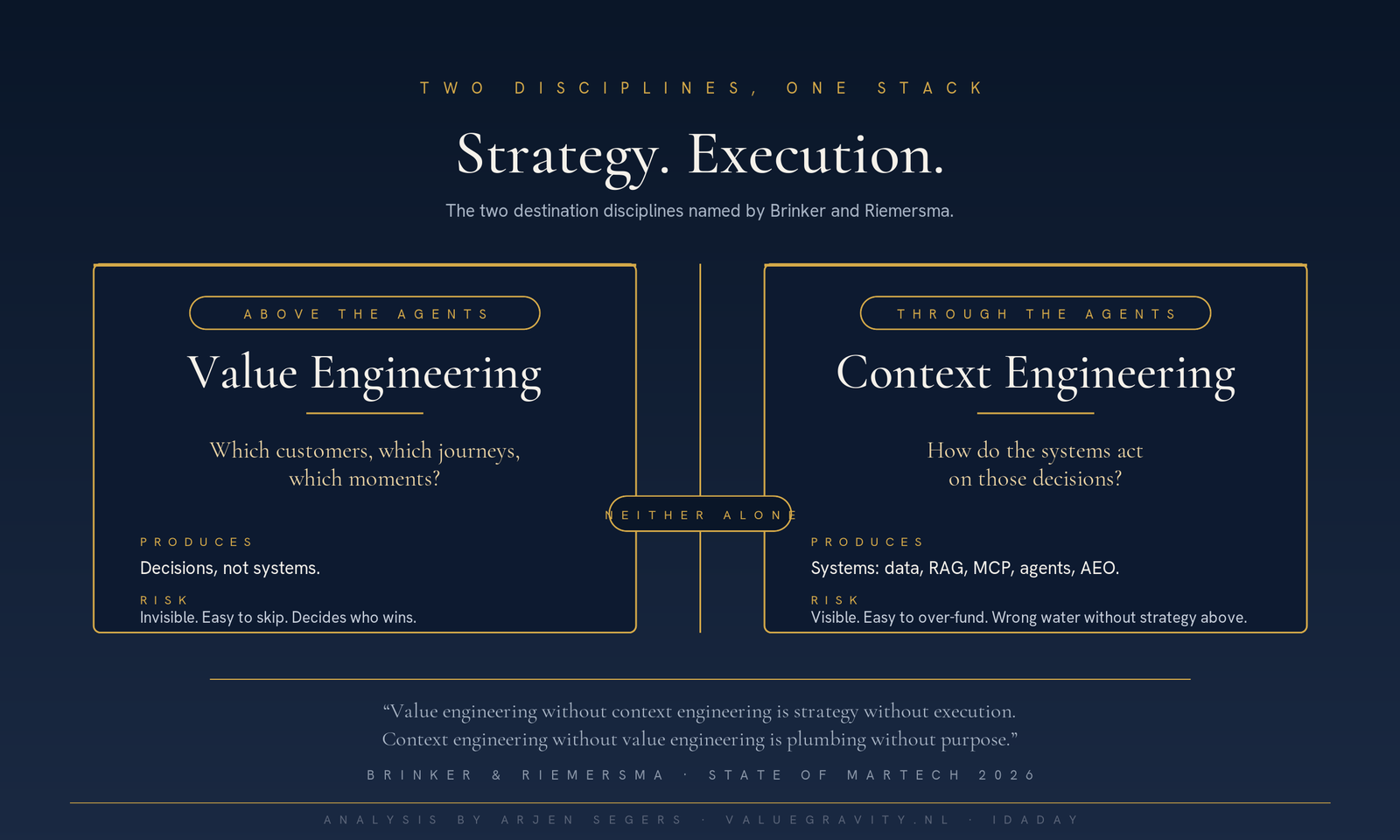
The report pairs the two disciplines and says neither is sufficient alone. Their phrasing: value engineering without context engineering is strategy without execution. Context engineering without value engineering is plumbing without purpose.
The second half is the one to sit with.
Context engineering will get the budget. It produces visible deliverables: data plumbing, RAG, MCP, agents, AEO. Easy to scope, easy to procure, easy to defend.
Value engineering is harder to see. It does not produce a system. It produces decisions about which customers, journeys, and moments to engineer for. The artefact is often one uncomfortable conversation in a leadership meeting.
A number of organisations will pour budget into context engineering over the next eighteen months and wonder why their personalisation does not move the needle. The plumbing will be excellent. The water will be wrong.
This is the gap Value Gravity™ has been built to address.
Value engineering, in five moves
Gravity attracts mass to mass. In marketing, value already concentrates around specific combinations of customer, journey, and moment. Some customers are worth more not because they buy more, but because they buy at higher margins, expand more, and require less air cover. The field is uneven, and most companies do not know what it actually looks like.
The job of the value engineer is to chart the field, deepen the wells, and align the company's orbit around them.
There are many ways to do this work. What follows is mine: the Value Gravity™ method, in five moves.
Click any move to read it.
Where does value already concentrate?
Map the field as it exists today. Which customers, products, journeys, and moments produce disproportionate margin, retention, expansion, and referrals. Reverse-engineer from outcomes.
Failure mode: confusing volume with value.
Why is the value concentrating there?
Sense gives you the pattern. Source gives you the cause. What were they hiring you for? What signal predicted the relationship? Not persona work. Personas describe correlations and rarely tell you what to do next.
Anthony Rotio at GrowthLoop draws the distinction in the report between predictive AI ("what will happen") and causal AI ("what to do"). Source is the human-led counterpart.
What would deepen the well?
Now design the offer, experience, and message that increases the gravitational pull. Positioning, packaging, brand, and product all plug in.
Failure mode: mistaking shape for surface. Polishing the website while the underlying offer was never designed for the well.
How do we align the organisation around the wells?
This is where value engineering either delivers or quietly dies.
Imagine: marketing rebuilds its dashboards around margin contribution. Sales is still paid on logos. Customer success is still measured on retention regardless of margin. The wells are mapped. The orbit does not change. Value engineering without organisational steering is a slide deck.
Resources, incentives, KPIs, channel mix, and territory model need to point at the deepest wells, not the easiest activity.
How do we compound the pull?
The field shifts. New customers enter. Old wells deplete. Treat value engineering as a habit, not a project. Cohort tracking, expansion economics, regular re-sensing.
Failure mode: one-and-done.
What this means for you
Three things worth doing this quarter.
Read the report. It will be the most cited piece of marketing analysis in 2026, and you want to be quoting it before your competitors are.
Spend an hour with the MartechMap, filtering by your region and stack profile. Ask your team which fifteen of the 15,505 tools you actually use, and which three carry the value.
Ask the three uncomfortable questions in your next leadership meeting. Where is the value actually concentrating right now, not last year? What are we doing on purpose to deepen the wells, and what are we accidentally doing that fights the gravity? What is the smallest organisational change that would shift the orbit?
Asked seriously and answered honestly, these three distinguish the marketing organisations that emerge from the chrysalis as recognisable butterflies from the ones that come out as something nobody recognises. Including themselves.
What this all adds up to
Brinker and Riemersma have given the discipline its name. The work is now to do the work.
Value Gravity™ is one method. There will be others. What there cannot be, in 2026, is marketing leadership that pretends this layer does not exist.
The report ends with a line that will be quoted often: content was king, context is the Monarch. If context is the Monarch, value engineering decides which grove the Monarch flies to.
Frequently asked questions
What is a value engineer in marketing?
A value engineer is a marketing leader whose job is to identify where economic value already concentrates inside the customer base, deepen those concentrations through deliberate offer and experience design, and align the organisation's resources around them. The term was named as the destination role for marketers in the State of Martech 2026 by Scott Brinker and Frans Riemersma, published on 5 May 2026.
What is the Value Gravity™ method?
The Value Gravity™ method is a five-move sequence for operationalising value engineering in enterprise marketing organisations. The five moves are Sense (where does value concentrate?), Source (why is it concentrating there?), Shape (what would deepen the well?), Steer (how do we align the organisation?), and Sustain (how do we compound the pull?). Each move has a specific question, a specific deliverable, and a specific failure mode.
What is the difference between value engineering and context engineering?
Value engineering identifies where economic value lives in the overlap of company goals and customer needs. It is strategic and reverse-engineered from outcomes. Context engineering assembles the data, content, tools, and instructions that allow AI systems to act on that value at the moment of decision. It is technical and forward-engineered from systems. The State of Martech 2026 names these as the two destination disciplines for marketing and marketing operations respectively, and explicitly states that neither is sufficient on its own.
Why will marketing organisations over-invest in context engineering?
Context engineering produces visible deliverables: data integrations, retrieval pipelines, MCP servers, agent workflows. These are easy to scope, budget, and measure. Value engineering produces decisions, not systems, which makes it harder to procure and harder to defend in a budget cycle. The likely outcome over the next eighteen months is that many enterprises will build excellent context engineering capability and still see flat conversion, because the underlying choice of which customers, journeys, and moments to engineer for has not been made deliberately.
How is value engineering different from segmentation?
Segmentation groups customers by shared attributes and applies differentiated treatment to each group. It is descriptive. Value engineering identifies where disproportionate economic value concentrates across the combination of customer, journey, moment, and offer, and then engineers the organisation around those concentrations. It is prescriptive. Segmentation is a useful input to value engineering. It is not a substitute for it.
Where can I read the State of Martech 2026?
The State of Martech 2026 is published by Marketing Technology Media and MartechTribe. The report is freely available at chiefmartec.com and martechtribe.com. The accompanying MartechMap is a filterable live version of the landscape data.