Marketo User Group Benelux · Adobe offices Amsterdam · 28 May 2026
Adobe Summit 2026 and Executive Forum summary.
Adobe Summit: Katja Keesom's talk
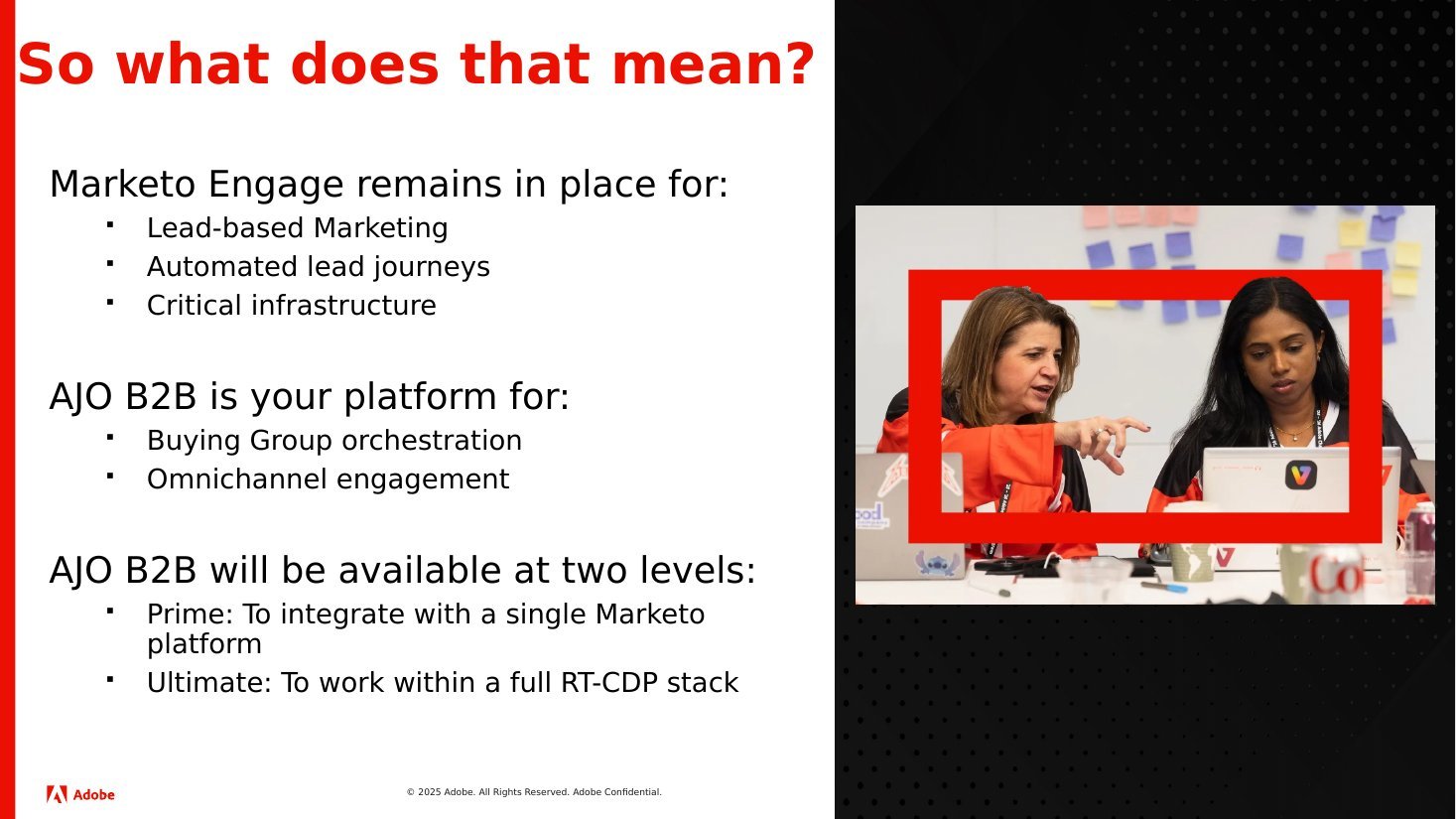
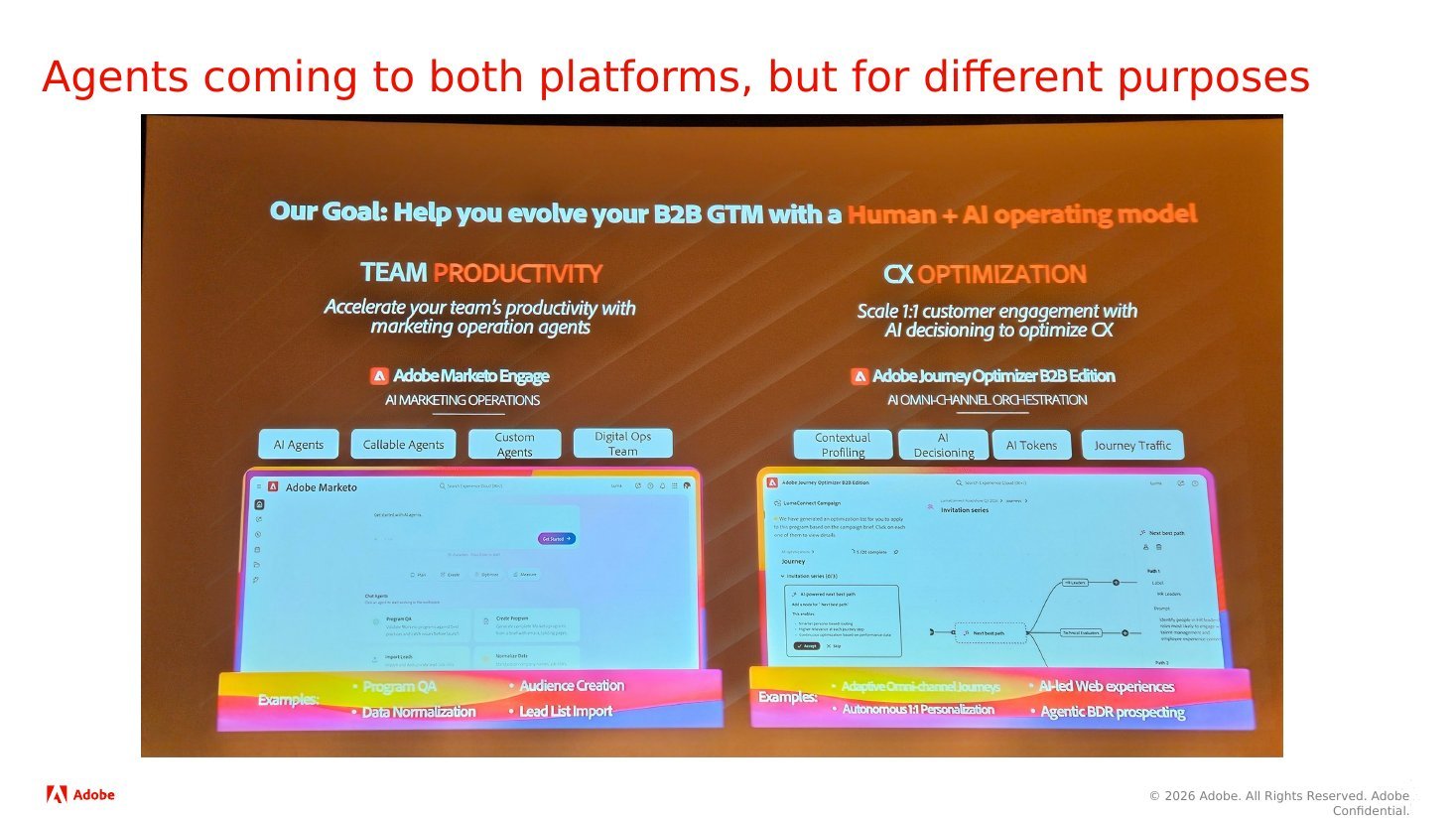
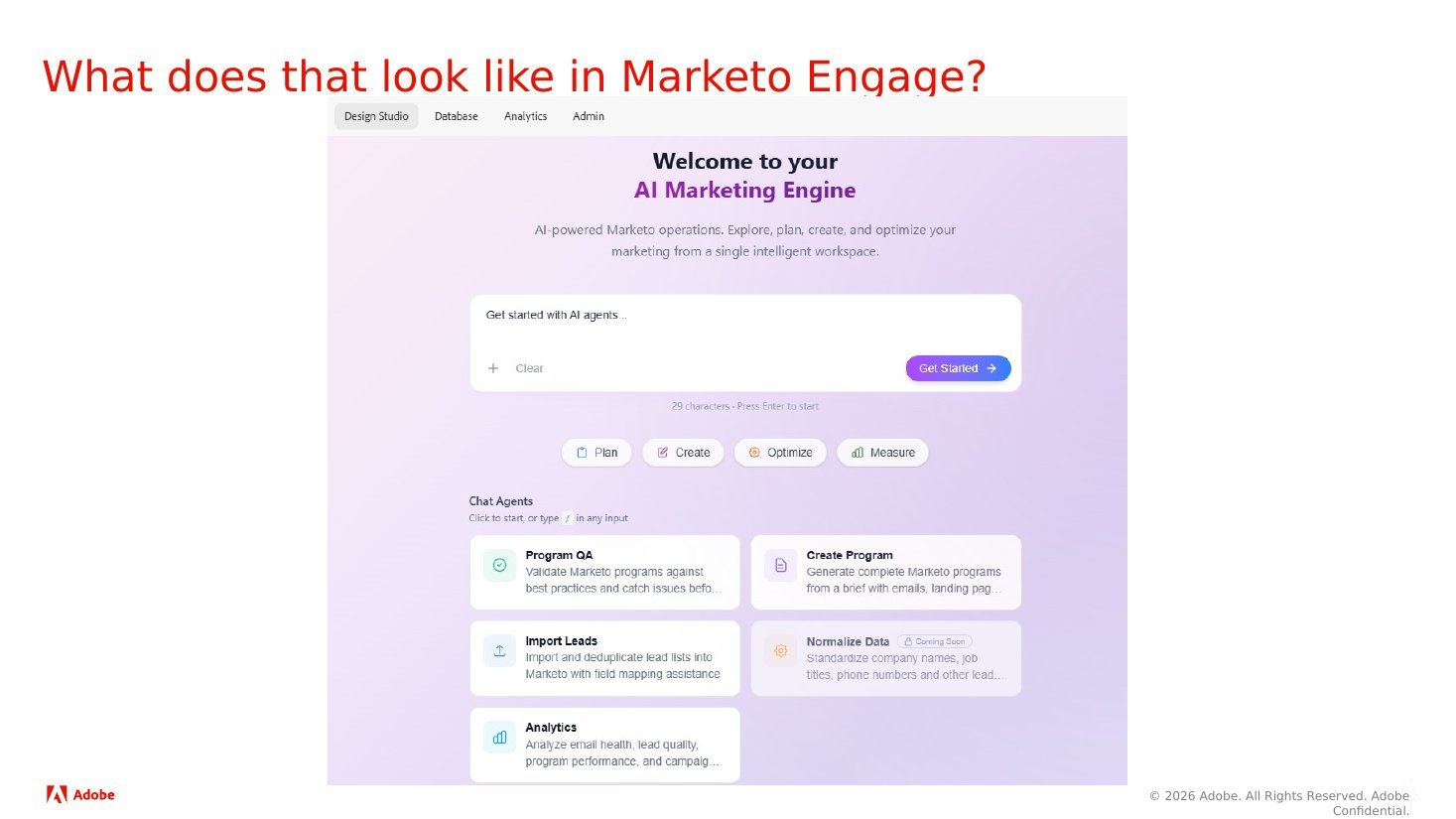
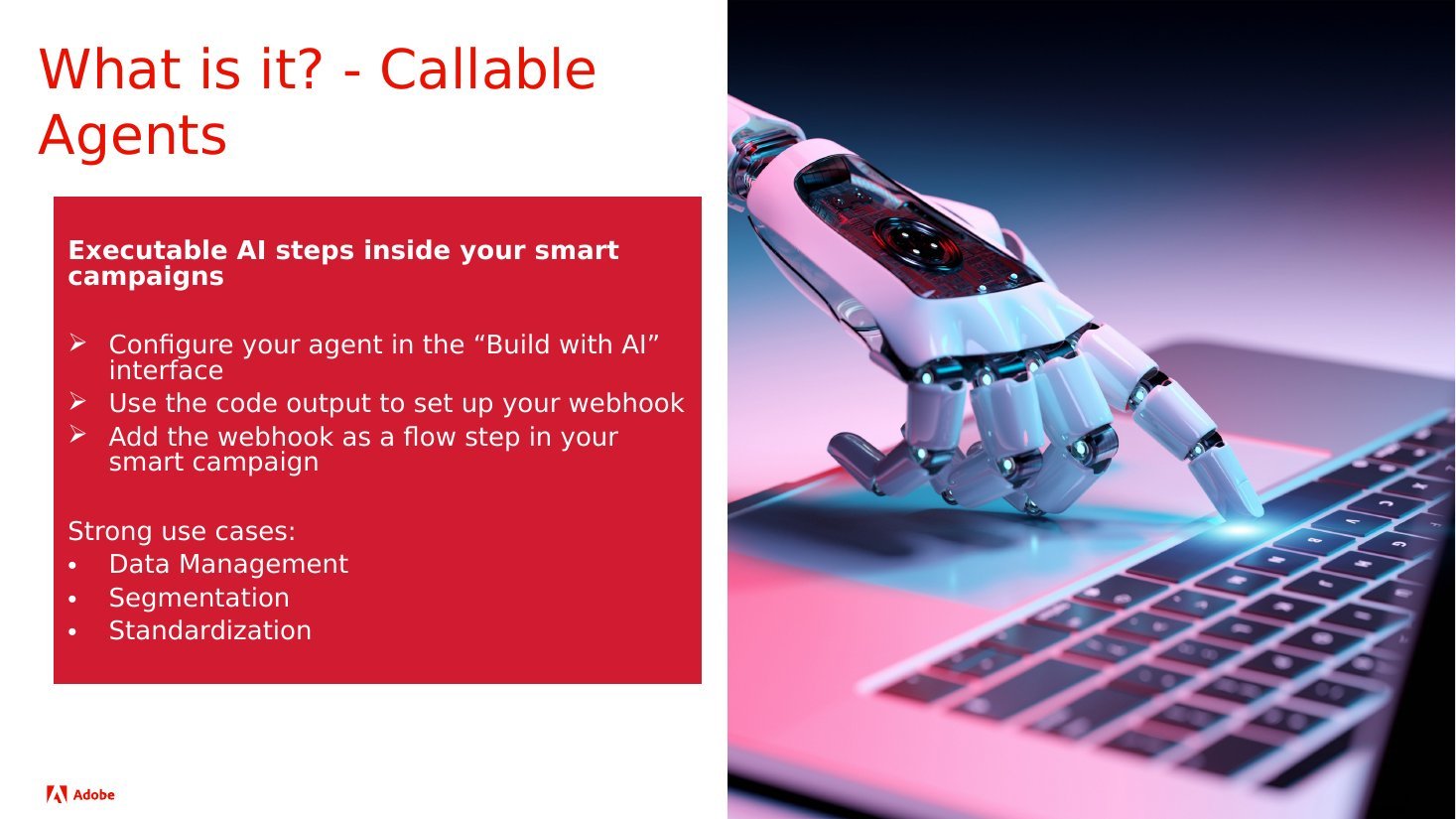
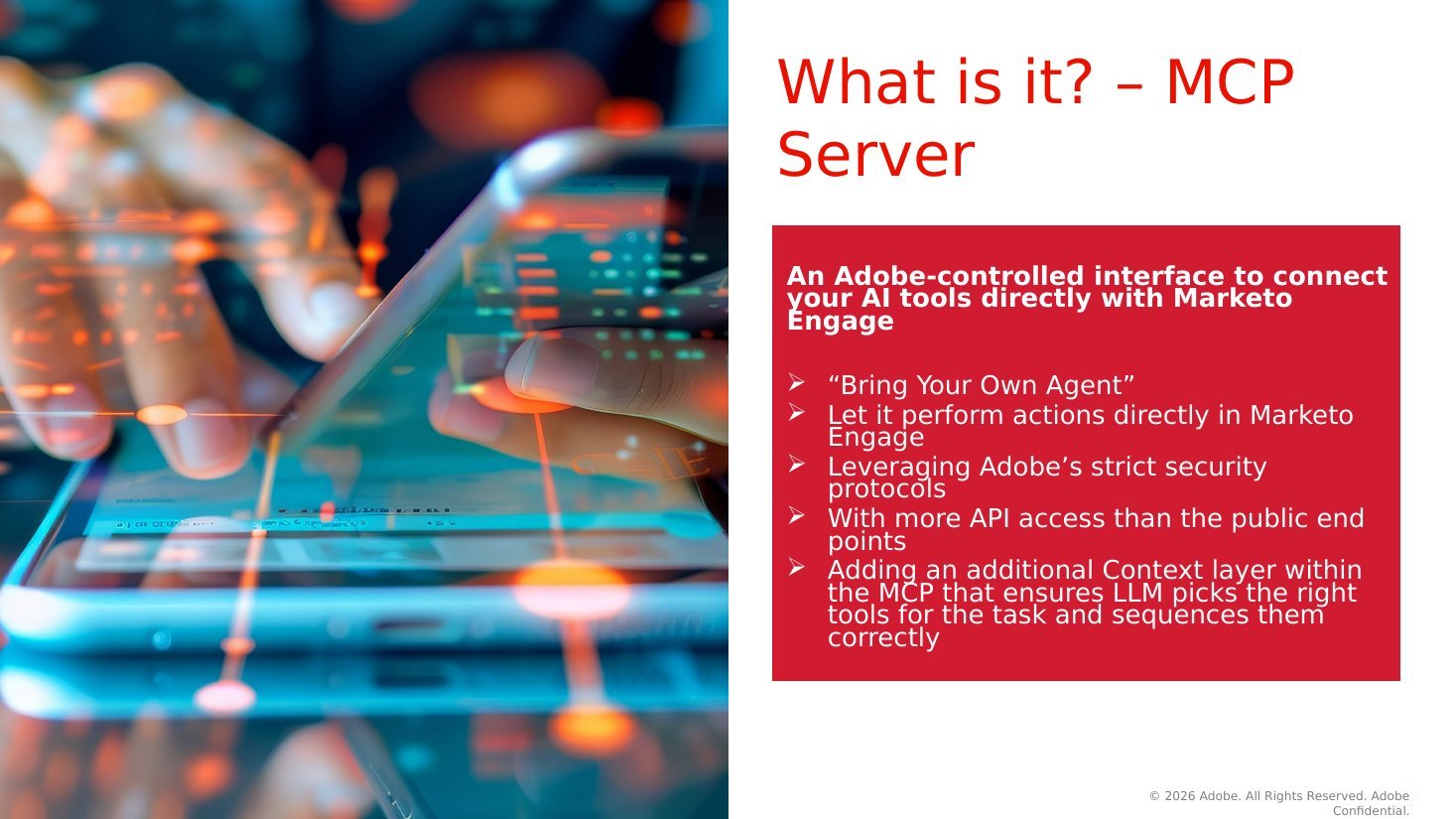
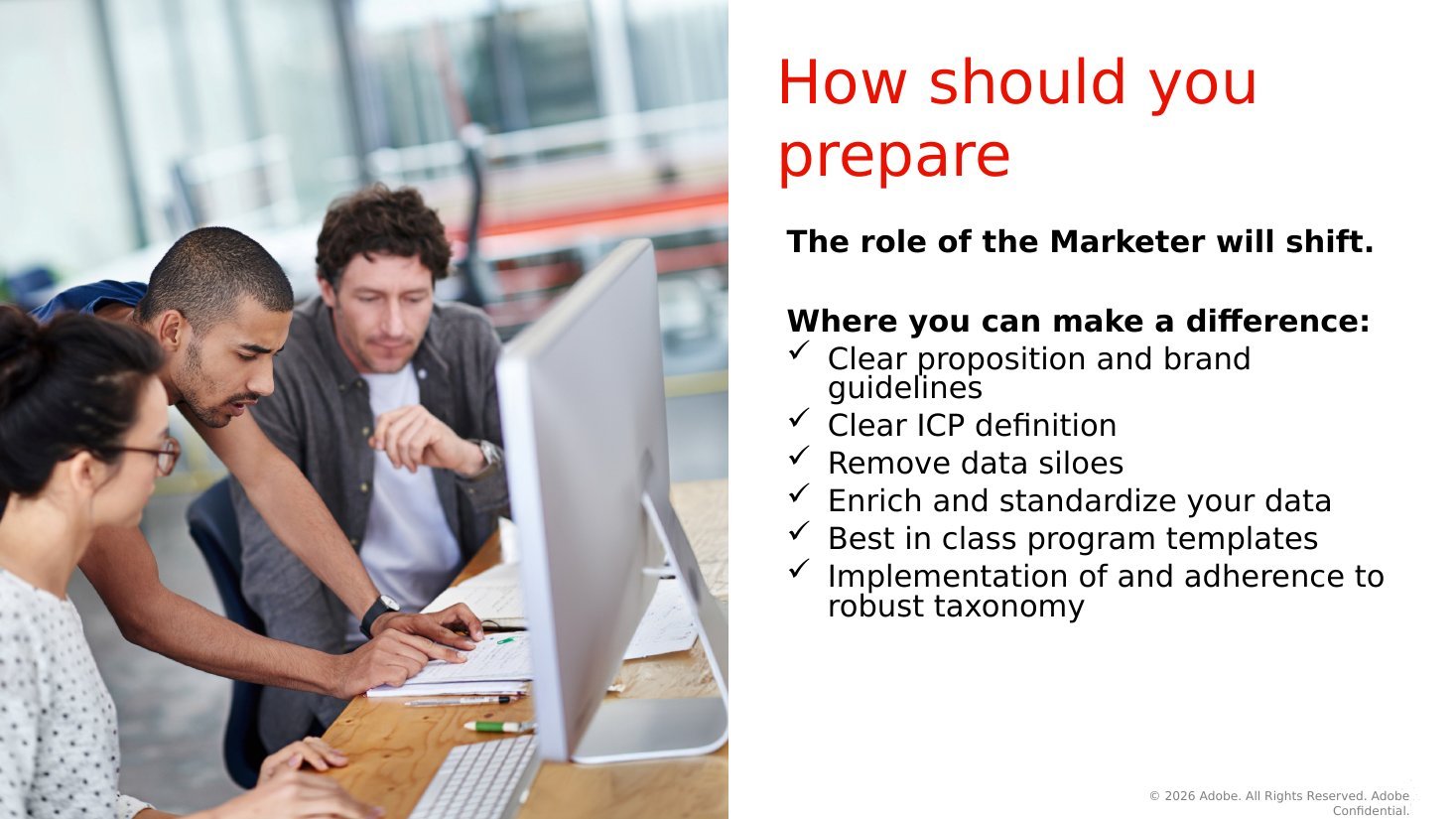
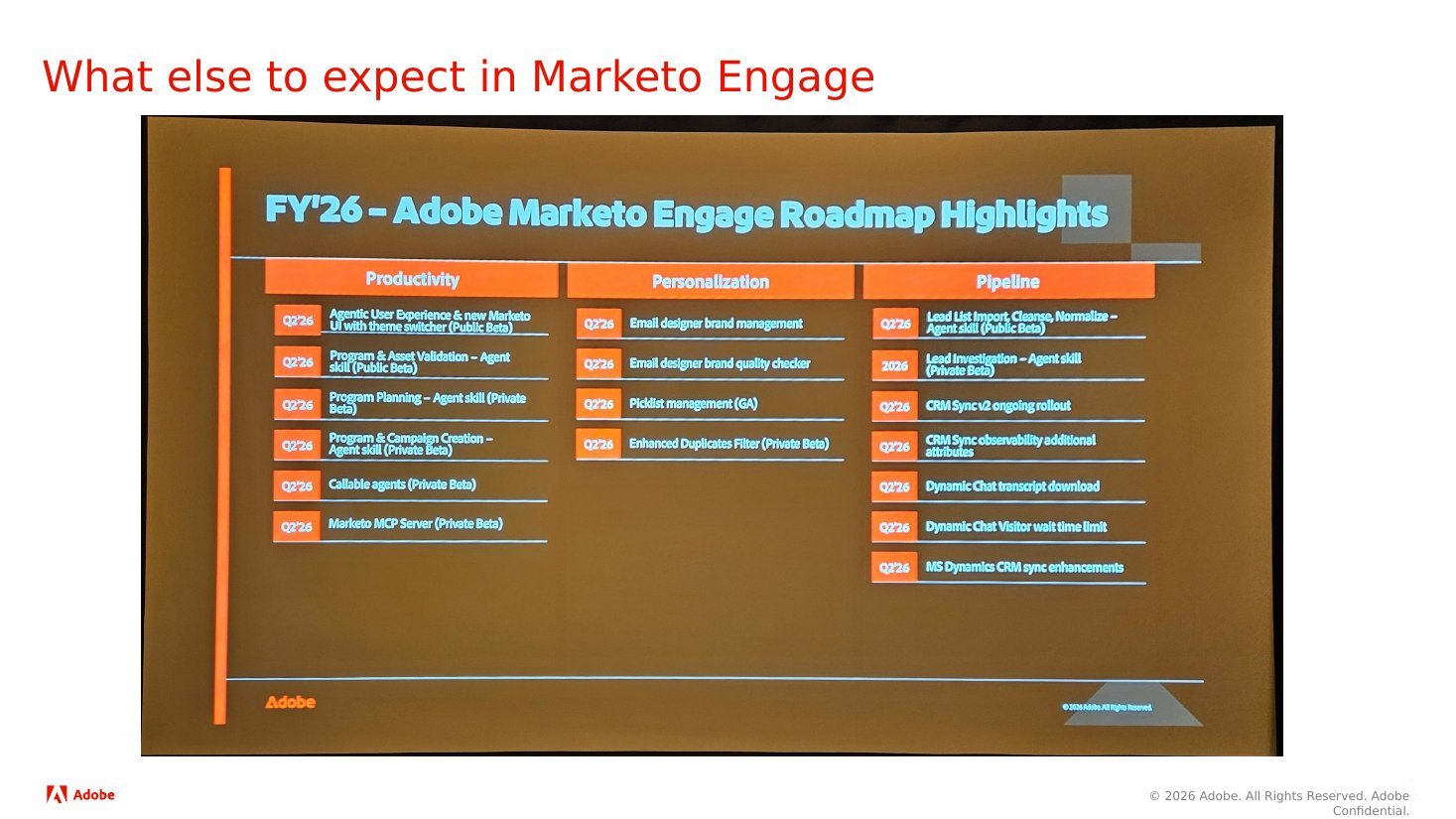
Show all 11 remaining slides +
About Katja. Katja Keesom is Adobe B2B Technology Lead at JTF, a 3x Marketo Champion and Marketo Champion of the Year. Marketo Certified Solutions Architect and Adobe Workfront Certified Project Manager. Connect on LinkedIn.
Executive Forum: Arjen Segers' talk
Show all 7 remaining slides +
About Arjen. Arjen Segers is an independent strategic advisor, marketing leader, and author of the Value Gravity™ framework on marketing technology. Connect on LinkedIn.
Leadership recommendations: Arjen Segers
For the CMO as a leader
Show all seven recommendations in detail +
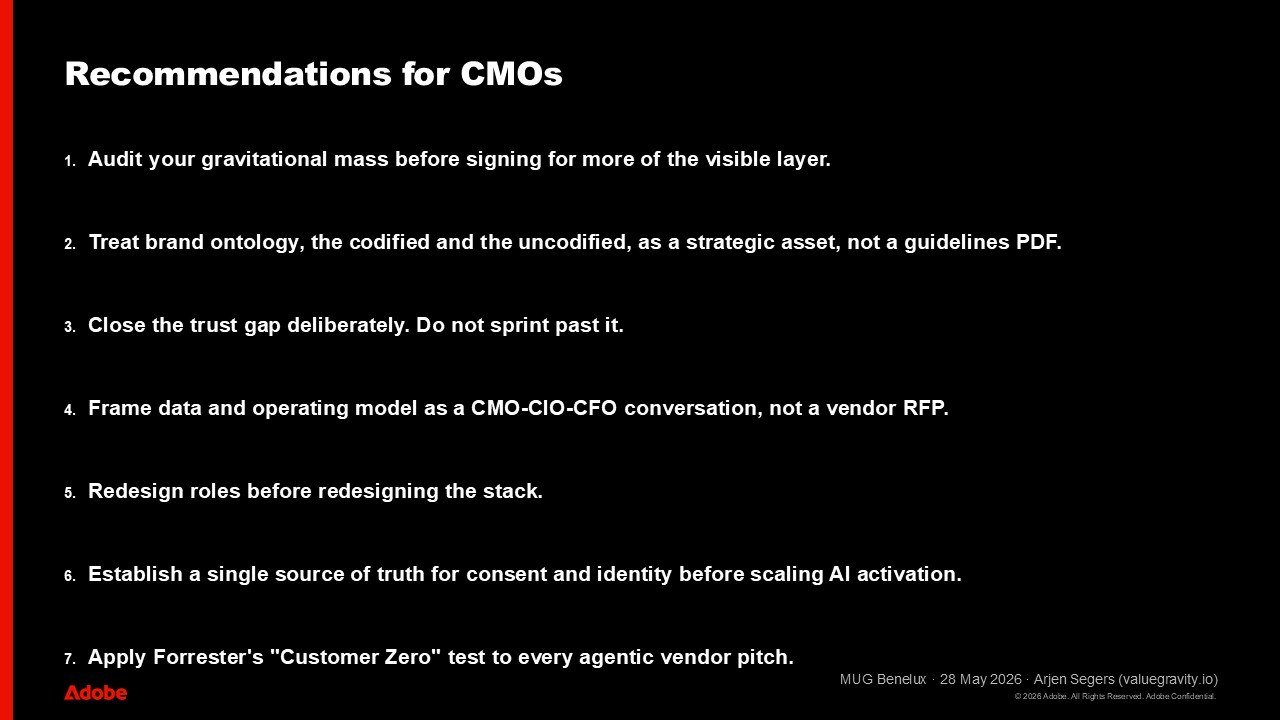
1.Audit your gravitational mass before signing for more of the visible layer.
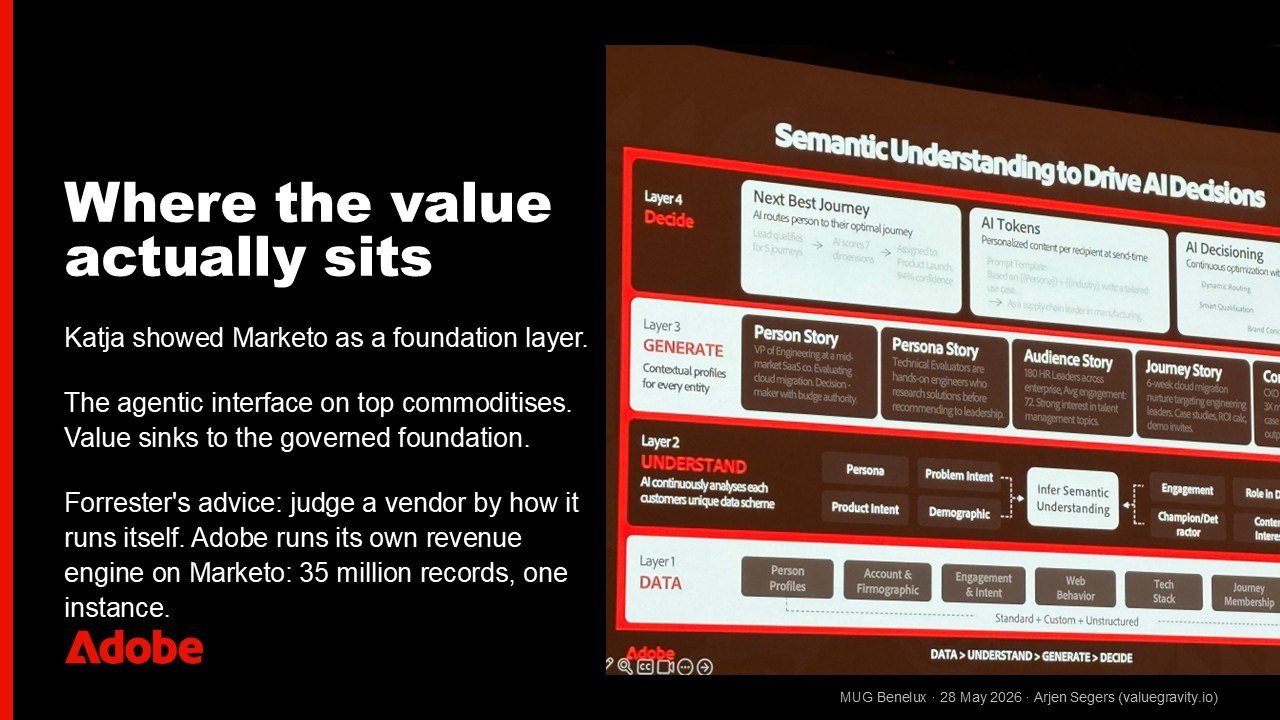
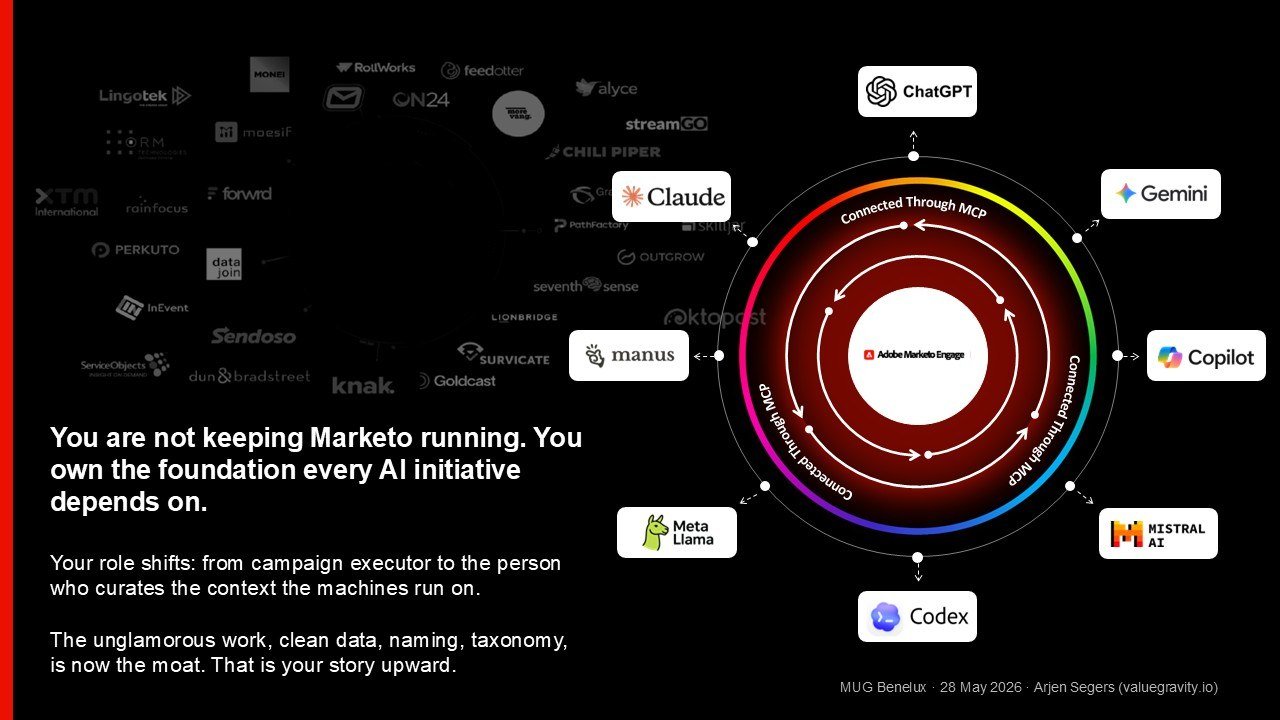
The visible layer of your stack, the conversational front end every vendor is now shipping, is the part that will commoditise fastest. Within twelve to eighteen months a functionally similar layer will be available from every serious vendor in the category. The strategic question is not which front end to standardise on, it is whether the mass underneath that front end is dense enough to carry it.
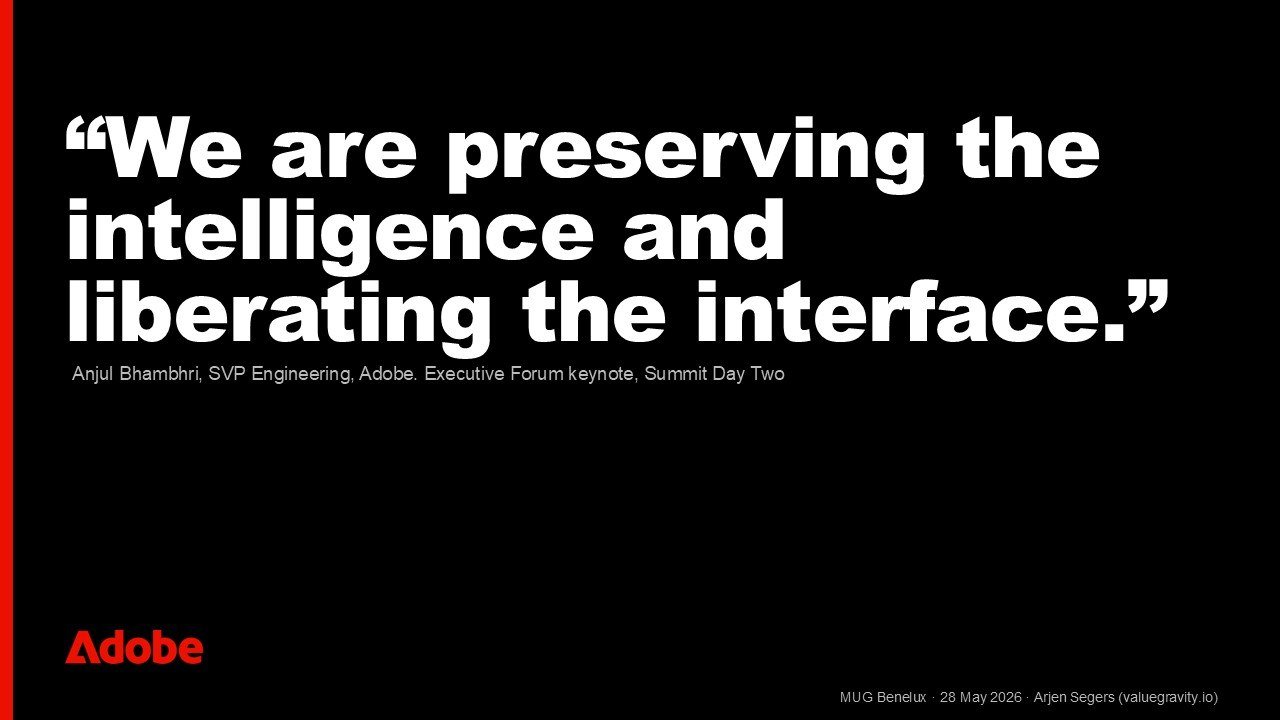
Adobe itself framed this on the Day Two keynote stage. Anjul Bhambhri, SVP of Engineering for Customer Experience Orchestration, put it in a single sentence:
"We are preserving the intelligence and liberating the interface."
Read it twice. The interface is the part that floats. The intelligence, your customer data and identity resolution, your brand ontology in both its codified and uncodified forms, your decisioning logic, your consent governance, the workflow context your teams use every day, is the part that stays.
Before approving further spend up top, commission a frank inventory of what you actually own at the base. The most useful executive question to ask after Summit is also the simplest. If every competitor has the same front end next year, what is still ours? If the answer is uncomfortable, the audit has done its job.
2.Treat the brand ontology layer as a strategic asset, not a guidelines PDF.
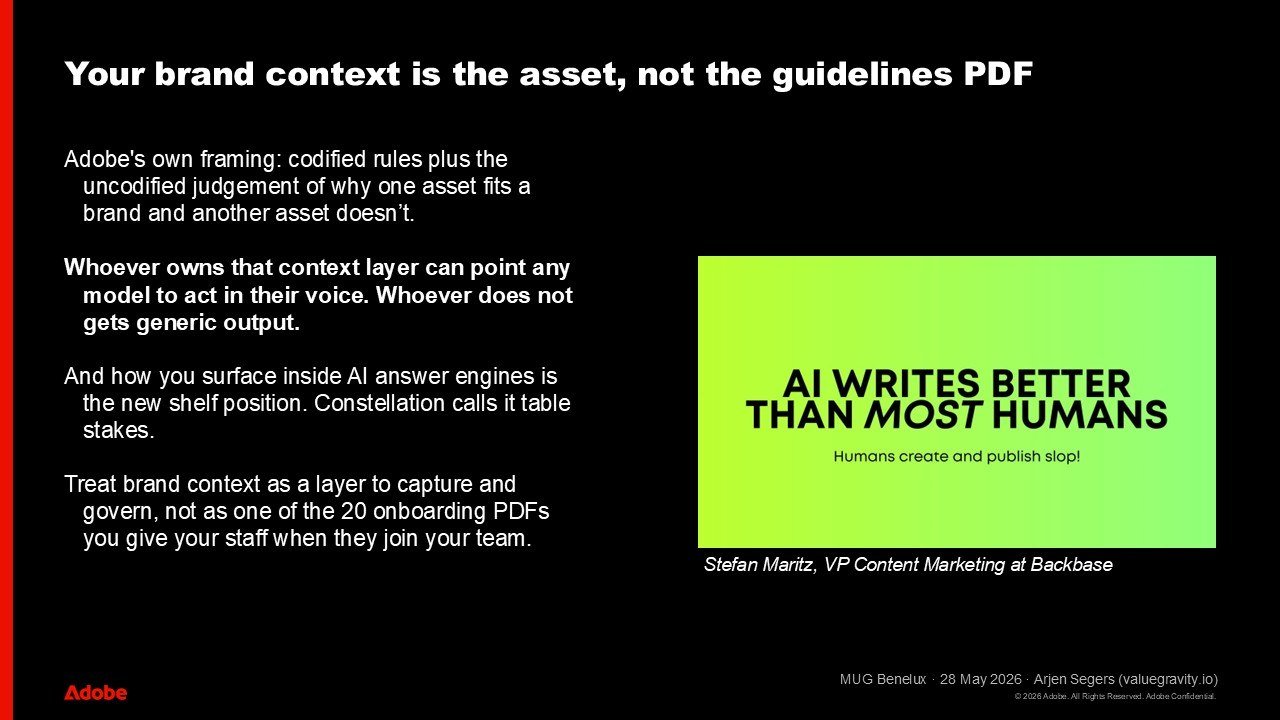
Most enterprises still think of brand as a deck of guidelines and a tone-of-voice document. The more useful concept is brand ontology: a structured map of what actually makes your brand distinctive in execution, including both the rules you have written down and the institutional judgement that has never made it onto a slide.
Varun Parmar, SVP and GM of Adobe GenStudio, named the gap with precision on the Day Two keynote stage. The codified layer, the brand briefs and kits and templates, is "just the tip of the iceberg." The real advantage, in his words, comes when you sit on top of "the uncodified majority: the institutional knowledge, human judgment, and decision patterns happening inside your organization."
Loni Stark made the same point with a sharper example: a brand lead who knows their voice needs to sound warmer on social than on product pages, where that distinction lives in the 9 p.m. "this isn't quite right" comments rather than anywhere a model can read.
Whoever captures, structures and governs that uncodified layer as a queryable asset can direct any model to act in voice. Whoever does not is using whatever generic context the model came with, which is no advantage at all. Commission the programme deliberately. Treat it as infrastructure, not as a marketing project, with budget, ownership and a roadmap that survives the next reorganisation.
3.Close the trust gap deliberately. Do not sprint past it.
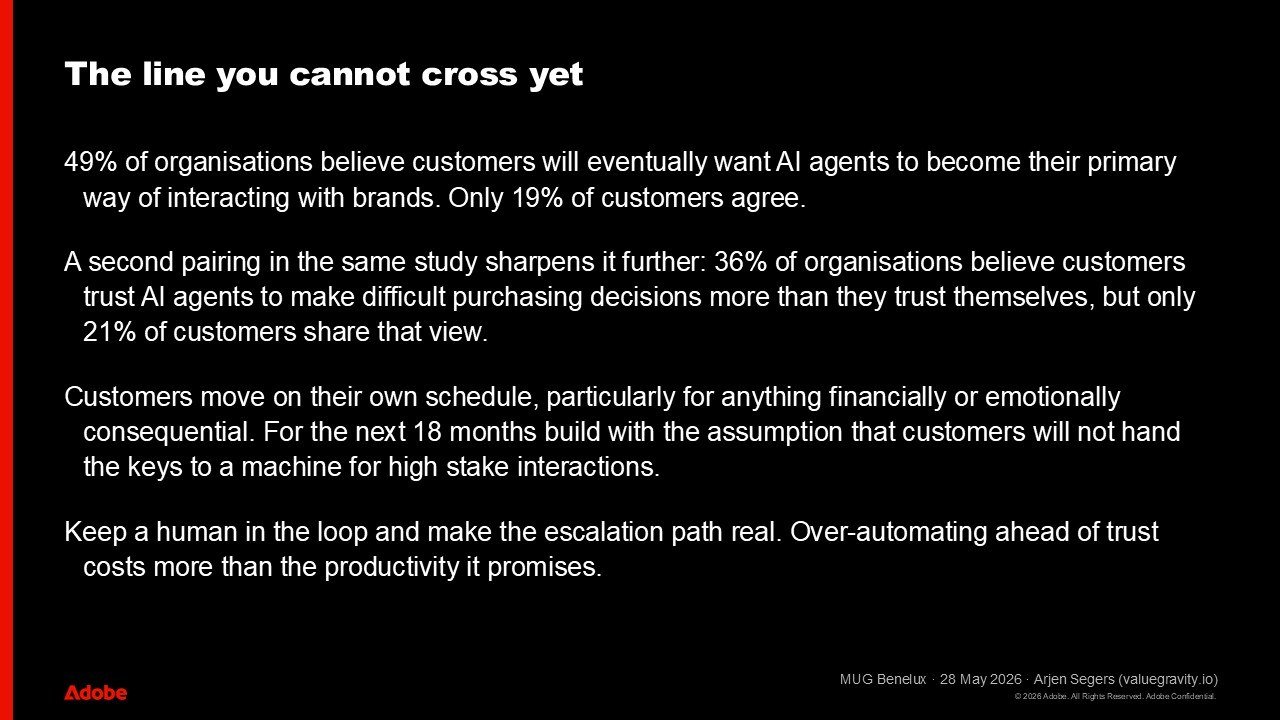
49% of organisations believe customers will eventually want AI agents to become their primary way of interacting with brands. Only 19% of customers agree. That is Adobe's own 2026 AI and Digital Trends Report, a thirty-point gap between brands and their customers about comfort with agents.
A second pairing in the same study sharpens it further: 36% of organisations believe customers trust AI agents to make difficult purchasing decisions more than they trust themselves, but only 21% of customers share that view. Two trust gaps, both running the same direction, both quietly assumed in most roadmaps to close on the vendor's timeline. They will not.
Customers move on their own schedule, particularly for anything financially or emotionally consequential. Build with the assumption that customers will not hand the keys to a machine for high-stakes interactions in the next eighteen months, even where your roadmap pretends otherwise.
That means human-in-the-loop is the default, not the fallback. The eject button is visible, not buried three menus deep. Escalation hands a real human the customer's full context, not a queue position and a transcript. Brands that over-automate before consumers are ready will pay for it with damage more expensive than the productivity they thought they were buying.
4.Frame data and operating model as a CMO-CIO-CFO conversation, not a vendor RFP.
75% of organisations name data integration and quality as the top barrier to agentic AI, ahead of talent and skills gaps at 71% and unclear return on investment at 68%. Those figures come from Adobe's own 2026 AI and Digital Trends Report. The most uncomfortable corollary in the same study: only 39% of organisations have a shared customer data platform capable of supporting agentic AI in the first place.
These are Adobe's numbers, presented at Adobe's conference, the same week Adobe announced products that depend on those foundations being in better shape than they are. The implication is clear. These are not problems a procurement decision will solve. They are operating-model problems, and operating-model problems need a coalition.
That coalition is the CMO, the CIO or CTO, and the CFO, sitting in the same room, agreeing on three things. Where the foundation of the organisation sits today. Where it has to sit in twenty-four months. And which function owns each piece of the work to close the gap.
Forrester's Joe Cicman made the deeper point during the cycle: autonomous AI is a forcing function on the operating model. It makes the existing organisational seams visible, and it does not move the needle on a stack laid over unchanged, siloed workflows.
5.Redesign roles before redesigning the stack.
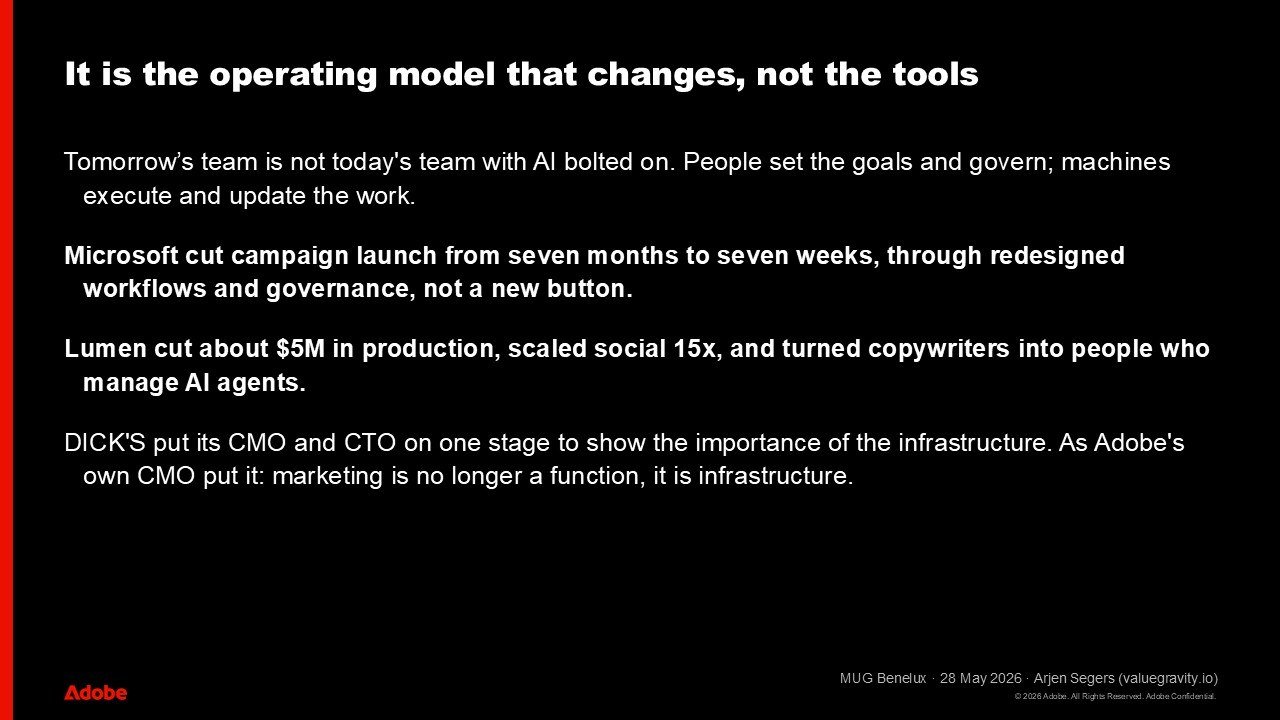
The frontier marketing organisation does not look like today's marketing organisation with AI added on. Kathleen Mitford, who runs Global Industry Marketing at Microsoft, described what one actually looks like in her Summit session. Three characteristics: humans focus on strategy, storytelling and creativity while AI sits inside their daily workflows; innovation and measurable outcomes are ubiquitous, not the property of a single innovation team; and AI is scaled with trust, with security, privacy and governance built in from the start, not bolted on later.
Microsoft's own marketing organisation is the live experiment. Over 75% of content workflows now involve AI, 70 to 80% of first drafts are AI-generated, asset production time is down by half, and campaign launch cycles have collapsed from roughly seven months to about seven weeks.
This is a structural shift, not a tooling shift, and CMOs who try to bolt new technology onto existing roles and existing processes will produce the worst of both worlds: people who feel threatened by tools they did not ask for, and outputs that feel generic because nobody has redesigned the surrounding judgement.
The harder, more valuable move is to redraw the org chart, the performance framework and the hiring profile first, then let the technology follow. Lumen Technologies offered a second proof point on the Adobe stage: copywriters evolving into content strategists who manage AI agents, personalisation reaching roughly fifteen times its previous scale, campaigns running about sixty-five percent faster, and around five million dollars in production spend taken out this year. The signal that you are taking this seriously is the simplest one available. Whether your next three marketing hires look meaningfully different from your last three.
6.Establish a single source of truth for consent and identity before scaling AI activation.
Walk into most enterprises and ask a simple question. What has this customer consented to, and who is the same person across our channels? The answer almost never comes back the same from marketing, service and commerce. Kate Parker of Transcend named this on the Summit stage and gave it a label worth borrowing: the governed data gap.
In her words: "they have a consent banner, a preference center, Adobe Journey Optimizer running their campaigns. They have a CRM, a CDP, maybe a data warehouse. And every one of those systems has its own version of what a customer has actually consented to and what their preferences are."
The policy looks consistent on paper. The production reality does not. Five autonomous workflows running in the same stack can each make a different lawful decision about the same customer in the same hour, none of them wrong locally, the aggregate incoherent and damaging.
Before scaling AI activation on top of that foundation, fix the foundation. As Transcend's Jess Dandorph framed the goal, you want "one authoritative answer to: is this member safe to activate right now for this purpose on this channel?" Build a single, governed source of truth for consent and identity that every downstream system reads from, not three reconciled-after-the-fact databases that drift between syncs. Unglamorous work. Also the work that decides whether the orchestration layer above it produces a coherent experience or an embarrassment.
7.Apply a "Customer Zero" test to every agentic vendor pitch.
Forrester's Joe Cicman put the cleanest discipline of the Summit cycle into one phrase. Customer Zero. Before believing any agentic AI roadmap, make the vendor show, in concrete detail, how it ran the same system inside its own operations first.
Not the slide. Not the published case study. The actual implementation. Which teams adopted it, what changed, what broke, what the new operating model looks like, what was learned that did not appear in the original pitch.
Adobe has published its own Customer Zero piece on its AI innovation approach, and that is part of the point of the test. A vendor that has done the work can talk about it for forty-five minutes without notes, and a vendor that cannot is leaning on a marketing artefact. A polished demo or a respected brand are not, on their own, evidence of Customer Zero.
Put "show us your Customer Zero" into every shortlist conversation as a standing question. Score the answer alongside price and features. Over a twelve-month evaluation period, the question separates serious vendors from the rest of the field faster than any reference call you will run.
For the CMO as a person
Show all four recommendations in detail +
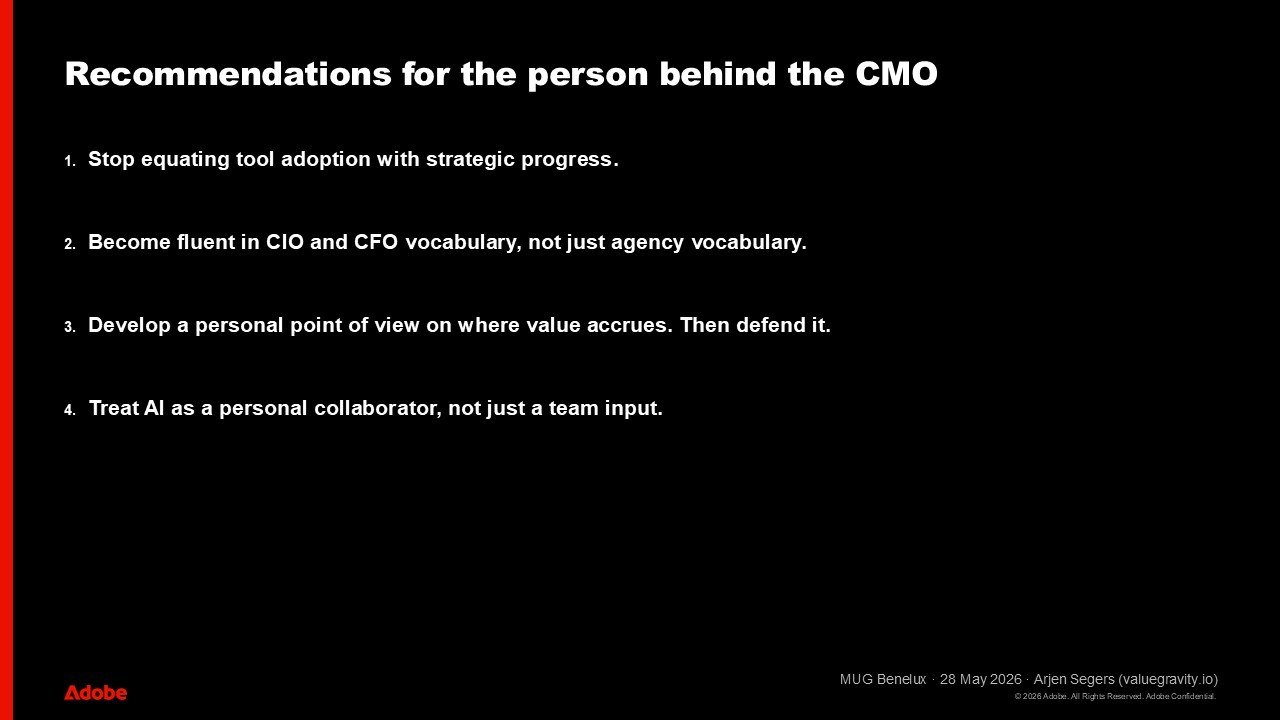
1.Stop equating tool adoption with strategic progress.
It feels productive to ship the latest tool. It looks productive in the all-hands update. It is what most marketing organisations have spent the last three years doing.
The uncomfortable truth is that adoption of the visible layer is not, on its own, evidence of strategic progress, because the visible layer is the part of the stack that commoditises fastest. If every competitor has the same tools by next quarter, your tooling adoption rate is not your moat, it is your table-stakes.
The scoreboard most marketing teams watch is measuring the wrong layer. Judge your own progress by whether the foundation underneath the tools got denser this quarter, whether your data is more usable, your identity resolution cleaner, your governance more confident. Those are the gains that compound. Adoption rates do not, and the next CEO conversation is the one that will surface the difference.
2.Become fluent in CIO and CFO vocabulary, not just agency vocabulary.
For a decade, the CMOs who got promoted were the ones fluent in agency vocabulary. Campaign frameworks, brand platforms, creative awards, channel jargon. That dialect is still useful, but it is no longer enough.
The decisions that decide the next twenty-four months of the business happen in two other vocabularies, data architecture and unit economics, and the people who speak them sit on the other side of the executive table. A CMO who can speak data architecture credibly to the CIO and ROI credibly to the CFO earns a seat in the room where the foundation decisions actually get made.
A CMO who cannot will sit in a different room, presenting decks that get politely received and then ignored. Fluency in two more dialects is the cheapest, highest-return personal upgrade available to a senior marketer in 2026. The reading lists and the conversations are not hidden, they are just not on the marketing trade-press shortlist.
3.Develop a personal point of view on where value accrues. Then defend it.
In a year when every vendor pitches a similar front end and every analyst report repeats broadly the same six things, the scarce asset for any senior marketer is a clear, defensible thesis on where economic value in this business actually accrues. That thesis is not the vendor roadmap. It is not the latest analyst quadrant. It is something the CMO has done the work to form, in their own words, and is willing to defend in front of the board.
The specific lens matters less than the discipline of holding one. Pick a frame, test it against the next ten things you read or hear, throw it out if it does not survive the test, and keep refining until it does.
It is worth noting that the language is in the air. P&G's Shailesh Jejurikar reached for a similar metaphor on the Day Two mainstage when he described "the power of shifting the gravitational force externally" as a turning point for one of his businesses. Forrester, Constellation and CCS Insight describe a similar pattern in different words, none of them yet naming it.
The CMOs who outsource the thinking to whichever roadmap is loudest in the room will spend a lot of money over the next twenty-four months and have very little to show for it. The CMOs who hold a view and apply it consistently across decisions will be much harder to dislodge, and much easier to follow.
4.Treat AI as a personal collaborator, not just a team input.
61% of leaders surveyed in Adobe's 2026 AI and Digital Trends Report now say employees should consider AI an indispensable coworker rather than just a tool. A striking number, but the more useful question is what those leaders actually do with it.
The pattern among the CMOs pulling ahead is that they use AI personally, not just operationally. They use it to think out loud before forming a position, to draft arguments before sharing them, to pressure-test their own logic before walking into a board meeting, to summarise reading they did not have time to do thoroughly.
The habit looks small from the outside, but it compounds quietly, and it shows up in the sharpness of the memos those leaders eventually put in front of the C-suite.
The CMOs who only think about AI as something their team operates downstream are missing the personal-productivity gain that turns out to be the more strategically important one. The cost of the experiment is fifteen minutes a day. The payoff is the rest of your career, and the people in the room with you will notice the difference before you do.
Share and cite
These slides and takeaways are meant to travel. Use them in your internal decks, on LinkedIn, in client conversations. Credit Arjen Segers and Katja Keesom for their respective material. For the written recommendations, a link back to this page helps the next reader find the full context.
Join the Netherlands Marketo User Group for future events.