The methodology I used to train every junior marketer
When I first led B2B marketing teams, I had a problem every marketing leader recognises: junior hires who understood tactics but not the system. They could write copy. They could set up campaigns. They could not explain how any of it connected to revenue.
My solution was not a training course or an expensive certification programme. It was HubSpot's content library.
Not the product - the thinking. The inbound methodology. How to earn attention instead of buying it. How content creates demand. How the buyer's journey shapes everything from the first touch to the closed deal. HubSpot had taken something that most B2B organisations struggled to articulate - the connection between marketing activity and business outcomes - and made it teachable. Nobody else had built anything as clear, as accessible, or as practical for explaining modern B2B marketing from first principles.
One letter, fifteen years
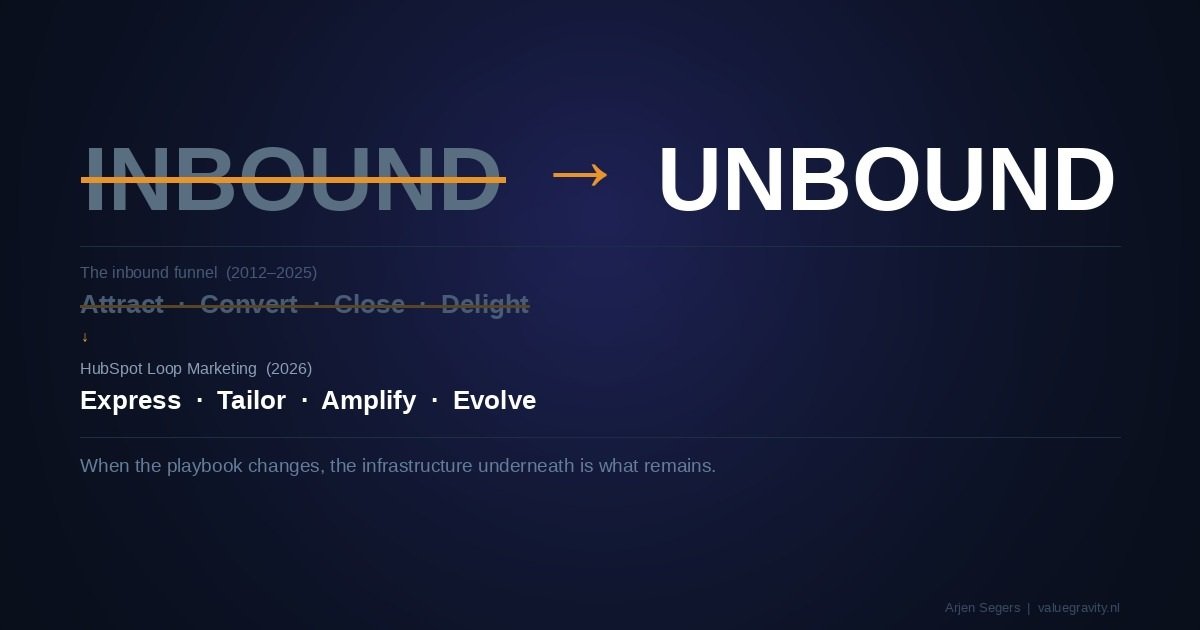
On April 6, 2026, HubSpot announced that its flagship conference INBOUND - held annually since 2012 - is being renamed to UNBOUND. The event returns to Boston for September 16-18, 2026, after a surprising detour to San Francisco last year.
The phonetic bridge between the names is deliberate. Close enough to signal continuity, different enough to signal a break.
HubSpot's explanation is direct: growth no longer fits within a single framework or function. Their customers no longer just run marketing teams. They run revenue organisations spanning marketing, sales, service, and operations. The methodology that anchored the conference for fifteen years - attract, convert, close, delight - is too narrow for what modern go-to-market teams actually manage.
That is a significant statement from the company that invented the framework.
HubSpot already shipped the replacement
It would be easy to read this as cosmetic. A fresh coat of paint on a fifteen-year-old brand. It is not.
HubSpot has already built the replacement thinking. In September 2025, at the San Francisco edition of INBOUND, they introduced Loop Marketing - a four-stage cyclical model designed to succeed the linear funnel that defined inbound. The stages - Express, Tailor, Amplify, Evolve - are built around continuous iteration rather than sequential conversion. Every marketing action feeds the next one. AI-driven personalisation replaces static segmentation. Multiple entry points replace the single-funnel assumption.
This matters because it tells you the conference rebrand is not the strategy. It is the last piece catching up to a strategy that was already in motion. HubSpot deprecated the inbound funnel in the product. They deprecated it in their marketing guidance. Now they are deprecating it in the event name.
The sequence is revealing: the company that built an entire category is systematically retiring it.
Why now
AI changed how buyers discover. The content-to-lead pipeline that powered inbound marketing - publish, rank, gate, nurture - depends on organic search traffic. That traffic is becoming less predictable. Buyers now find answers through AI-powered search and large language models before they ever click a link. HubSpot's own blog, long considered the gold standard for B2B content marketing, was significantly impacted by Google algorithm changes in 2025. The very mechanics that inbound marketing was built on are shifting underneath it.
HubSpot outgrew its own category. The platform has evolved from marketing automation into what they now describe as an agentic customer platform - spanning CRM, sales, service, operations, and AI agents. The product already crossed the boundaries the conference name still implied.
Four visits from Europe
I attended INBOUND four times, flying in from the Netherlands each year. By then I had moved on from HubSpot as a customer. I kept coming anyway.
The conference had become something larger than the product or the methodology. Dharmesh Shah on stage, thinking out loud about culture and code and what makes companies worth building. Practitioners sharing what actually worked - not vendor-scripted success stories, but honest experiments and hard-won results. Running into Mike Rizzo and Jay Schwedelson - we somehow ended up picking the same hotels every year - people who are actively shaping how B2B marketing works in practice.
That community was always bigger than the product and bigger than the methodology. The event did not survive because of the inbound framework. It survived because of the people who gathered around it.
I was already surprised when they moved from Boston to San Francisco last year. That felt like a company searching for what comes next. The name change makes the intention explicit.
What this means for B2B leaders
HubSpot's move is one data point, but it reflects a broader pattern worth paying attention to.
The methodology era - the period where you could adopt a single framework (inbound, ABM, product-led growth, demand gen) and build your entire go-to-market around it - is closing. Not because the frameworks were wrong, but because the environment they were designed for has fundamentally changed.
AI did not just add a new channel. It restructured how buyers find information, evaluate options, and engage with vendors. The linear playbooks that worked in a search-dominated, content-gated world need to evolve into something more adaptive, more integrated, and more dependent on connected infrastructure.
Go-to-market needs to be cross-functional by design, not by accident. The silo between marketing, sales, and customer success is not an organisational quirk. It is a structural risk. HubSpot's own evolution - from marketing platform to customer platform - mirrors what its customers have been living through. The companies getting this right are building connected operating models, not bolting departments together after the fact.
The infrastructure underneath matters more than the playbook on top. This is the lesson that keeps repeating. Whether you run HubSpot, Marketo, Salesforce, or any other stack, the quality of your data, your governance, and your system integration determines what any methodology can actually deliver. A brilliant playbook on a fragmented foundation produces impressive reports and mediocre revenue.
The ability to adapt continuously is replacing the ability to execute a plan. HubSpot's Loop Marketing is one expression of this principle, but it applies regardless of vendor. Static annual plans and rigid funnel stages are losing to teams that iterate weekly, test constantly, and treat their go-to-market as a system that learns. The organisations that struggle most are the ones still looking for the next single framework to follow.
September update: what happened between the rename and the conference
Four things since April, and they lean the same way.
HubSpot tried to pool customer data, and reversed within four days. On 1 July, updated terms allowed enrichment data from customer portals to flow into a shared dataset, on by default, effective 4 August. On 5 July, CPTO Duncan Lennox published "We Got This Wrong. And We Are Fixing It", withdrew the terms and committed that any future enrichment will be fully and transparently opt-in. No return date has been given. I wrote about it in July; the reading has not changed. Companies retreat that fast when the thing at stake is strategic. The dataset ambition remains. The consent mechanics failed.
Commerce Hub became Revenue Hub. On 16 June HubSpot renamed Commerce Hub to Revenue Hub, a full quote-to-cash system inside the CRM: quoting, contracts, subscription billing, payments. The July releases added HubSpot Capital, actual working-capital financing for US and UK customers. Two renames in one quarter, both pointing away from marketing and toward money. A CRM vendor that offers its customers financing has told you which record it wants to own.
Agents moved to outcome pricing, and the customer count wobbled. Q2 results on 5 August: revenue of $911.7 million, up 20 percent; 306,446 customers, up 14 percent; 7,000 net new customers against an expected 9,000 to 10,000, and the outlook trimmed to 5,000 to 6,000 a quarter. HubSpot introduced outcome-based pricing for several agents, lowered entry prices, and reported some downgrade pressure as customers optimise their spend. Meanwhile the agents are being used: Data Agent on 16,000 customers, up 80 percent in one quarter; Prospecting Agent on almost 17,000; Customer Agent above 10,000 and resolving 72 percent of tickets without a human. Yamini Rangan's line to analysts: "Customers want proof of value before they buy. This is a different buying motion than SaaS and where they bought features."
The company that taught a generation to rank now sells a tool for getting cited. 32 percent of Marketing Hub Professional and Enterprise customers have activated HubSpot's AEO tool, and nearly 16,000 have started a stand-alone trial. In April I wrote that AI changed how buyers discover. HubSpot has since productised the answer. The inbound funnel is being rebuilt one layer up, inside AI answers.
And the agenda itself. UNBOUND runs 16-18 September 2026 in Boston, at a convention centre that was itself renamed last year (it is now the Thomas Michael Menino Convention and Exhibition Center, so the conference is in good company), with a partner day on 15 September and a sold-out notice on the website. Dreamforce runs the same week in San Francisco, 15-17 September, under the banner of the agentic enterprise. The HubSpot Spotlight keynote on Wednesday morning is Yamini Rangan with her product leadership; Dharmesh Shah follows in the afternoon; the analyst day is Thursday 17 September. Around them: the CMOs of JPMorganChase and Zoom, Anthropic's head of enterprise for the Americas, a Databricks engineering VP, and then Tom Brady, Cynthia Erivo, Aziz Ansari, Mel Robbins and astronaut Suni Williams. I know which queue I will be in, and it will be the shorter one. The developer track titles do the strategic talking: "HubSpot's Agent-Era Roadmap", "Open Platform Vision for the Agent Era", "Close the Context Gap". The stated theme is "connected systems, AI-driven execution, and unified teams".
Read the agenda next to the four developments above and one direction appears: down the stack, toward data, context and the revenue record. That is where a customer platform earns its switching costs, and HubSpot knows it.
Three things to watch in Boston
1. Whether the pool comes back, and in what paperwork. HubSpot has promised that any future enrichment will be opt-in. Boston is its first big stage since the retreat, and prospecting agents need data to prospect with; the July episode showed where HubSpot would like that data to come from. Listen for "network", "aggregated", "professional data" and "enrichment" in the Spotlight keynote and at the analyst day. The customer test stays what it was in July: does the value created in your portal stay in your portal, or does it flow into theirs?
2. Seats becoming credits, and what that does to your budget. Outcome pricing is customer-friendly. It also ties HubSpot's revenue to how much of your operating model its agents run. This year that shows up as downgrade pressure. In two years it shows up as consumption nobody budgeted. The analyst day on 17 September is where the 2027 margin story gets told to investors, in plainer language than any keynote; read that transcript before you read the product announcements. Then decide who in your organisation approves agent actions and spend thresholds. The licence no longer caps the bill.
3. Who closes the context gap, and who holds the context afterwards. "Close the context gap" is HubSpot's own session title. MCP, connectors, a Data Agent doubling in a quarter: HubSpot is moving into the connective tissue between your systems, the layer where value settles in the Value Gravity™ model. If HubSpot closes your context gap, HubSpot holds your context. That can be the right decision. Make it deliberately, and know that the switching cost lands exactly there.
None of this will be said from the main stage in those words. Keynotes sell velocity. Value settles lower, and more slowly.
Fifteen years is a good run
HubSpot built something rare. A company that educated its market - not as a marketing tactic (though it was brilliant marketing), but as a genuine contribution to how a profession thinks about its work.
The fact that they are willing to evolve past it - publicly, with a single-letter change that carries fifteen years of weight - says something about the intellectual honesty of the leadership team.
UNBOUND sold out. I am flying in for the fifth time.
Not for the methodology. For the people. Same as always. If you are in Boston that week, say hello.
Frequently asked questions
When and where is UNBOUND 2026?
UNBOUND 2026 runs 16-18 September 2026 at the Thomas Michael Menino Convention and Exhibition Center in Boston, with a partner day on 15 September and HubSpot's analyst day on 17 September. The event is sold out.
Why did HubSpot rename INBOUND to UNBOUND?
HubSpot announced the change in April 2026. Its explanation: a name rooted in one methodology from the internet era was no longer enough for a company that now calls itself an agentic customer platform across marketing, sales, service and operations. The conference had carried the INBOUND name since 2012.
Is UNBOUND the same conference as INBOUND?
Yes. Same organiser, same September slot, back in Boston after the 2025 edition in San Francisco. New name, wider remit, and a keynote line-up that mixes CMOs with celebrities.
What is Loop Marketing?
HubSpot's successor to the inbound methodology, introduced on 3 September 2025 at INBOUND in San Francisco. Four stages, Express, Tailor, Amplify and Evolve, designed as a continuous cycle; the linear funnel is retired.
Did HubSpot's data pooling change go ahead?
No. The 1 July 2026 terms were withdrawn on 5 July, before the 4 August effective date. HubSpot has committed that any future enrichment will be fully and transparently opt-in and has not announced a date.
The Value Gravity™ Model maps where economic value accumulates in a marketing stack - and where it does not. It makes the infrastructure argument concrete: not which platforms you run, but where gravity pulls value in your specific configuration.