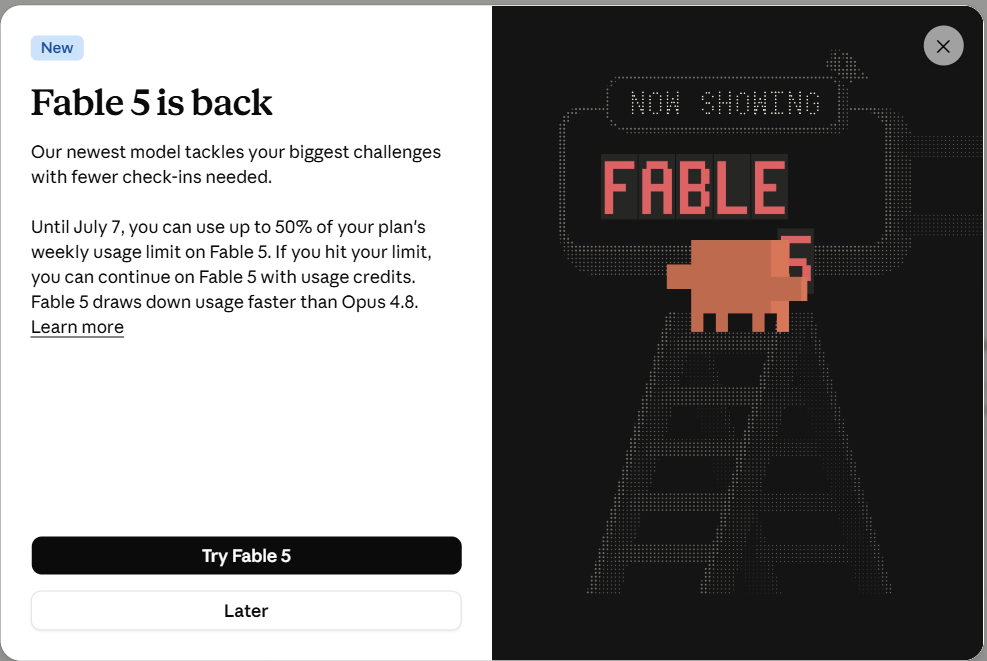
Access held. The terms did not. After Fable 5 came back on 1 July the plan-included promotion was set to end on 7 July, then extended to 12 July, then to 19 July, and on 18 July Anthropic made the arrangement permanent on new terms: included in Max and Team Premium at half the weekly limits from 20 July, with Pro and Team Standard moved to usage credits and a one-time $100 credit. Three deadlines in eighteen days, each resolved at the wire. That is the same event as the export order in a different coat, and it is the reason the resilience question below did not actually go away.
In June 2026 the US government forced Anthropic to take Fable 5 and Mythos 5 offline with an export-control order. The controls were lifted on 30 June and Fable 5 returned on 1 July; Mythos 5 is back for a set of US organisations. The episode changes nothing about the durable lesson: when a model can be pulled overnight by forces outside your control, keep your value in the layers you own and treat the model as a part you can swap.
It is over, for now. The US Department of Commerce lifted the export controls on 30 June, and Fable 5 came back across Anthropic's platforms on 1 July; Mythos 5, the heavier cybersecurity model, is returning to a set of US organisations that defend critical infrastructure (Anthropic, CNBC). Nineteen days gone, and now back, by a decision made in a room you were not in. The resilience question this piece opened with did not go away. It just stopped being urgent.
Earlier updates (12-22 June 2026)
Ten days after the shutdown, Fable 5 and Mythos 5 are still offline, but a resolution looks close. Anthropic's international MD Chris Ciauri told a press conference in Seoul the company is "very confident" the models return "in the coming days", and Anthropic and the administration are reported to be working toward a deal (Globe and Mail, Korea JoongAng Daily). One detail proves the point of this piece: during the week the model was gone, teams simply routed work to alternatives, open-weight models among them (The New Stack). The fallback was the strategy. For now, access remains suspended.
Over the weekend Anthropic flew senior engineers to Washington to negotiate the controls away. According to reporting from Quartz and TechTimes, Commerce Secretary Howard Lutnick and White House cyber director Sean Cairncross joined Saturday's talks. The models are still offline, with no timeline for return. Worth noting for the argument here: whether your access comes back now turns on a negotiation between a vendor and a government, a room you are not in.
New reporting from Politico fills in the backstory. The export controls followed a 24-hour push by cabinet-level officials, including Treasury Secretary Scott Bessent, Commerce Secretary Howard Lutnick and White House cyber director Sean Cairncross, to get Anthropic to pull Fable voluntarily after Amazon, an Anthropic investor, and others flagged a way around the model's guardrails. Anthropic's CEO pushed back, calling it a specific bypass rather than a universal jailbreak; the government then imposed the controls. Accounts differ on how much warning Anthropic was given. The structural point below still stands: your access became collateral in a standoff between a vendor and a government. Access remains suspended.
Status: Fable 5 and Mythos 5 remain offline. Anthropic says it disagrees with the order, calls it a misunderstanding based on a narrow jailbreak, and is working to restore access. All other Claude models are unaffected. We will update this piece as the situation changes.
At our last Marketo user group I put up an ecosystem diagram with Claude sitting in it as one box among many. Marketo was the example; the same picture holds for any marketing automation or CRM platform. This week the US government showed why that one box behaves differently from the others around it.
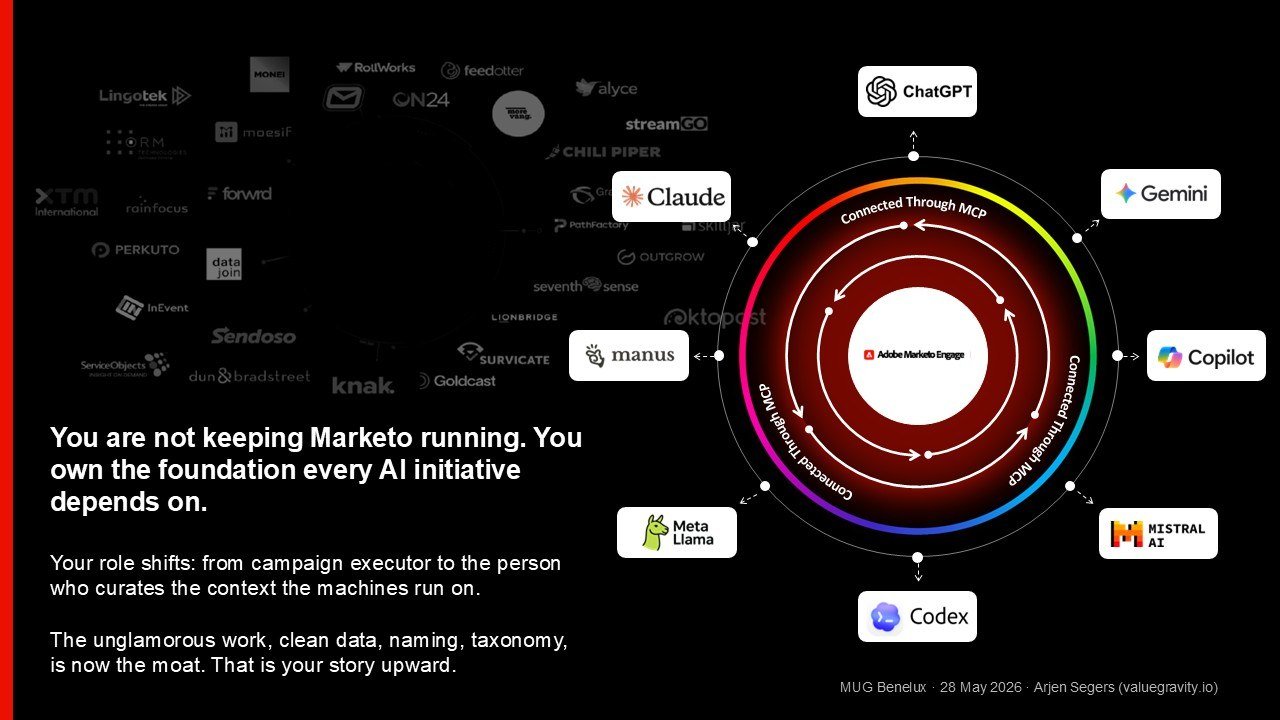
On that slide I told the room their job was moving from running campaigns to curating the context the machines run on. Two weeks later, one of those machines was switched off by government order.
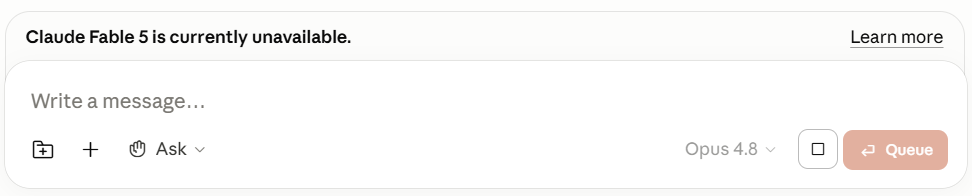
On 12 June, Anthropic pulled its two newest models, Fable 5 and Mythos 5. The reason was an export-control directive from the US government. As far as I can tell, it is the first time a government has reached into a live large language model and switched it off.
Most of us build on a quiet assumption: that models only ever get faster, cheaper and easier to reach. This is the week that assumption broke.
What actually happened to Fable 5 and Mythos 5?
Here is the short version. On 12 June the US government issued an export-control order covering Fable 5 and Mythos 5, barring access for any foreign national, inside or outside the United States, including Anthropic's own foreign staff. Anthropic can't check nationality in real time, so it pulled both models for everyone. Every other Claude model, Opus 4.8 included, kept running.
Mythos 5 is Anthropic's specialised cybersecurity model, built to find software flaws and write the patches. Fable 5 is the broader model on top of it. The government pointed to a way of jailbreaking Fable 5 to reach those offensive capabilities. Anthropic disagrees in public: it calls the technique narrow, says it surfaces only minor and already-known flaws, and points out that other public models, OpenAI's GPT-5.5 among them, can do the same. It is complying while it contests.
Strip away the cybersecurity drama and one fact is left standing. A model that a great many people used on Thursday was gone on Friday, on an instruction nobody in the market saw coming or could appeal in time.
Is my Claude access affected?
For most people, no. The order names Fable 5 and Mythos 5 and stops there. Claude Opus, Sonnet and Haiku, the apps and the API all keep working. You feel this only if you built on Fable 5 or Mythos 5 directly, or used them from outside the US, in which case access vanished with no warning and no migration window.
That narrow blast radius is exactly why this deserves your attention rather than your panic. Small this time. The precedent is the part that travels. A capability can now leave your stack because of where your users hold their passports, and your architecture, your contract and your roadmap get no vote.
Why this is a Value Gravity™ problem, not just an AI-news story
This is exactly the moment my framework was built to read.
The principle that the deep, governed, high-switching-cost layers of the enterprise stack (data, identity, customer relationships, brand) pull economic value downward, while the exciting AI layer on top is low-mass and commoditises quickly.
The model sits at the top of the stack: the brightest, fastest-moving part, and the part you control least. Friday made the point bluntly. The top layer can vanish overnight, this time by export law rather than any market move you could hedge. Durable value lives lower, in the layers you own and govern. The model is a swappable input dressed up as the main event.
Which brings me back to that slide. If your job is curating the context the machines run on, this is the week it paid off, because the context you own, your data, your taxonomy and your governance, is the part that survives when a machine is taken away.
There is a sharp edge here if you are reading from Europe, or anywhere outside the United States. This was a foreign-national restriction. In that sentence, you are the foreign national. Sovereignty risk in the AI layer just stopped being a line in a governance deck and became a Friday-night email. If your value depends on a model another country can bar you from, that is now a board-level fact.
Offline is offline: the cause barely matters
A model can leave your stack for all kinds of reasons: an outage, a price rise, a retired version, an acquisition, a licence change, and now a government order. The trigger keeps changing. The exposure stays the same. The only question worth asking is how much of your value sits in a layer you do not control.
It is tempting to file this under geopolitics and move on, because an export order feels rare and exotic. That is the wrong lesson. Anthropic models have had outages this year. Providers retire versions on their own schedule. Prices move. Vendors get bought. Every one of these is the same event in a different coat: something you depend on becomes unavailable on someone else's timetable. The export ban is the most dramatic costume the risk has worn so far, which makes it a free fire drill for a question you should already have answered.
How do you stop a vanished tool from taking your value with it?
You can't stop a vendor or a government from pulling a model. You can make sure your value doesn't walk out with it. Keep the things that compound, your data, your logic and your governance, in layers you own, and treat the model as a part you can swap.
Six moves, in rough order of leverage:
- Map your gravity. Write down which capabilities hang off a single model at the top, and which live in layers you own: your data, your identity graph, your orchestration logic, your governance. Your exposure is the concentration up top, and most teams have never drawn it.
- Keep value in the layer you own. Your data, prompts, evaluation sets and orchestration logic should travel with you. If switching models means rebuilding all of that, you don't have a tool, you have a landlord.
- Abstract the model. Route business-critical flows through a provider-agnostic interface instead of wiring one model's API straight in, so swapping the model underneath is a setting you change.
- Qualify a fallback in advance. Keep a second model already tested against your prompts and evaluation sets before you need it. A Friday-night scramble is the worst time to learn your prompts behave differently elsewhere.
- Make continuity a foundation decision. Vendor risk, export risk, data residency and contractual exit belong in governance, owned at board level, the way you treat any other concentration risk. Outside the US, jurisdiction is now part of how you choose a model.
- Match dependence to maturity. Let experiments ride the newest, most exciting model. Keep production revenue flows on governed, swappable foundations. It is the same split I argued for in treating most AI work as laboratory work: the lab can run the concept car, the factory can't.
Build on mass, rent velocity.
So what should a leader take from a Friday-night shutdown?
The exciting part of your stack and the dependable part live in different places, and Friday showed how far apart they can sit.
The teams that treated the model as a swappable input read the news, checked their fallback, and got on with their weekend. The ones who had let their value drift up into a single vendor's model spent it rearchitecting. When the brightest thing in the room can be switched off by someone you will never meet, you want your value sitting somewhere with a lower centre of gravity.
That is the whole of it. Don't anchor what compounds to the layer you control least.
Frequently asked questions
What happened to Claude Fable 5 and Mythos 5?
On 12 June 2026 the US government issued an export-control directive barring all foreign nationals from Anthropic's Fable 5 and Mythos 5 models, so Anthropic disabled both for everyone to comply. The US Department of Commerce lifted the controls on 30 June 2026, and Fable 5 returned on 1 July; Mythos 5 is being restored to a set of US organisations. Anthropic had called the order a misunderstanding based on a narrow jailbreak.
Is regular Claude (Opus, Sonnet, Haiku) affected?
No. The directive applies only to Fable 5 and Mythos 5. All other Anthropic models, including Claude Opus 4.8, and the Claude apps and API remain available. You are only affected if you built specifically on Fable 5 or Mythos 5, or relied on them as a non-US user.
Can I still use Fable 5 or Mythos 5 in Europe?
Yes, again. Fable 5 returned globally on 1 July 2026 after the export controls were lifted, so European users have access once more. Mythos 5, the heavier cybersecurity model, is limited to a set of US organisations. For nineteen days in June, everyone outside the US lost access without notice, which is exactly the risk this piece is about.
How can I protect my business when an AI tool goes offline?
Keep the things that compound, your data, your orchestration logic and your governance, in layers you own, and treat the model as a swappable input. Route through a provider-agnostic interface, qualify a fallback model in advance against your own prompts and tests, and own continuity and vendor risk at board level rather than as a procurement detail.
What is Value Gravity™?
Value Gravity™ is the principle that the deep, governed, high-switching-cost layers of the enterprise stack (data, identity, customer relationships, brand) pull economic value downward, while the exciting AI layer on top is low-mass and commoditises quickly. It was developed by Arjen Segers.